
Agentic software development is defined as a methodology where autonomous AI agents independently plan, write, test, and deploy software across the full software development lifecycle, with humans acting as orchestrators rather than line-by-line coders. This is the standard industry term for what some call "AI-native development," and it goes far beyond autocomplete or code suggestion. Teams that adopt agentic approaches across the entire SDLC see individual task gains of 30–40%, while those limiting AI to coding alone see less than 10% team productivity gain. That gap is the core argument for understanding what is agentic software development and why it matters right now.
What is agentic software development, and how does it differ from AI coding tools?
Traditional AI coding tools handle isolated tasks. They suggest a function, complete a line, or flag a syntax error. Agentic software development covers the full arc: requirements analysis, architecture decisions, code generation, test writing, debugging, and deployment. The agent does not wait for your next prompt. It plans, executes, checks its own output, and adapts.
The human role changes fundamentally. You shift from writing code to reviewing agent plans, setting constraints, and approving outputs before they merge. Agentic AI shifts developers from writing code to orchestrating autonomous agents by designing intelligence, guardrails, and workflows. That is the biggest change in software engineering workflows in 2026.
Productivity tells the story clearly. Limiting AI to code completion yields marginal team gains. Deploying agents across planning, build, and test phases compounds those gains at every stage. A team using an agent only for autocomplete is like hiring a contractor and asking them only to sharpen pencils.
Pro Tip: Start by mapping your current SDLC stages before introducing agents. Knowing where handoffs happen helps you identify which stages benefit most from autonomous execution.
Core principles that define agentic software development
Agentic software development rests on three pillars: agency, breadth, and targeting professional coders rather than low-code users. Each pillar shapes how teams adopt and govern these systems.
Agency means the AI autonomously decomposes a goal into subtasks, executes them in sequence, and self-corrects when outputs fail validation. The agent does not need a human to specify every step. It reasons about the problem, selects tools, and iterates.

Breadth means coverage of the full SDLC. An agentic system handles planning, design, build, test, and deployment. Agents that only touch one phase are not truly agentic. They are specialized assistants.
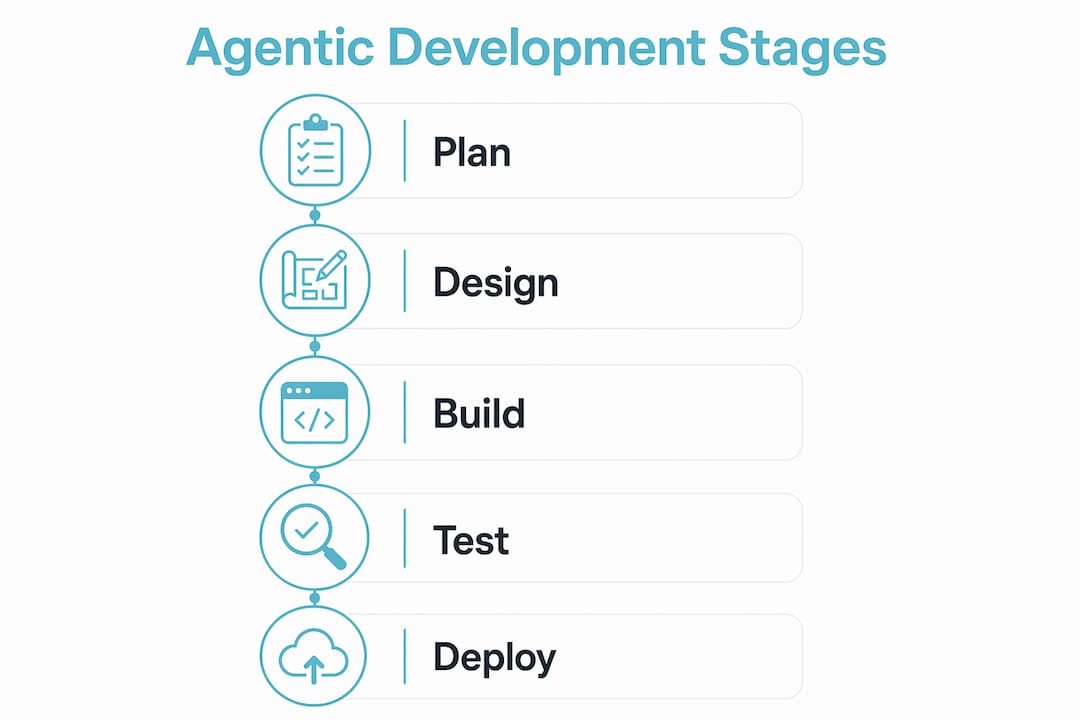
Professional coder targeting is the third pillar. Agentic development is built for engineers who can evaluate agent outputs, catch hallucinations, and set meaningful constraints. It is not a low-code shortcut. The developer's judgment is the quality gate.
Additional principles that guide agentic software engineering include:
- Iterative self-correction: Agents validate their own outputs against defined criteria before surfacing results to the developer.
- Structured Agentic Software Engineering (SASE): Researchers at arxiv.org describe dual modalities where software engineering processes exist for both humans and agents, enabling bidirectional collaboration.
- Governance-first design: Governance-first paradigms like ArbiterOS treat agents with structured policies rather than ad-hoc control, preventing drift and unauthorized actions.
- Earned autonomy: Agents earn greater independence by demonstrating reliability on simpler tasks before handling complex, multistep workflows.
Pro Tip: Treat your agent's autonomy level as a dial, not a switch. Start with narrow, well-defined tasks and expand scope only after the agent proves consistent on those.
What frameworks power agentic software development?
The framework you choose determines how much control you retain and how well agents collaborate. Top agentic frameworks in 2026 include CrewAI, LangGraph, AutoGen, LlamaIndex, DSPy, Haystack, and Microsoft Semantic Kernel. Each takes a different approach to agent coordination.
Here is how the major categories break down:
| Framework type | Orchestration model | Best suited for |
|---|---|---|
| Single-agent (e.g., DSPy) | One agent, one task chain | Focused, linear workflows |
| Multi-agent (e.g., CrewAI, AutoGen) | Multiple agents with defined roles | Complex, parallel SDLC coverage |
| Graph-based (e.g., LangGraph) | State machine with conditional branching | Workflows requiring adaptive decision trees |
| Kernel-based (e.g., Microsoft Semantic Kernel) | Plugin architecture with memory | Enterprise integration and tool orchestration |
Choosing a framework is not about picking the most popular option. It is about matching the framework's coordination model to your team's workflow. A small team running focused build tasks benefits from a single-agent setup. A team running parallel planning, testing, and deployment agents needs multi-agent orchestration with clear role boundaries.
Agentcohort integrates agents including Claude Code and OpenAI Codex into a single multi-terminal grid. Each project gets its own dedicated environment, so agents do not bleed context across tasks. That separation is a structural advantage when running multiple agents simultaneously.
How to implement agentic software development in your team
Workflow redesign is three times more strongly correlated with successful agentic adoption than incremental tool changes. Layering an agent on top of an existing process rarely works. The process itself must change to accommodate autonomous execution loops.
A practical agentic workflow loop follows four stages:
- Goal: The developer defines the objective in clear, scoped terms. Vague goals produce vague agent outputs.
- Plan: The agent generates a step-by-step execution plan. The developer reviews and approves it before any code runs.
- Execute: The agent carries out the plan, using tools, writing code, and running tests autonomously.
- Adapt: The agent evaluates its own outputs, identifies failures, and revises before surfacing results.
Governance cannot be an afterthought. Trust and governance are essential because agents can hallucinate or propagate defects, requiring structural controls such as identity management and test-before-merge protocols. Every agent action should be traceable. Every merge should require a passing test suite the agent did not write in isolation.
The "Plan-mode-default" principle is one of the most practical governance tools available. Successful teams enforce Plan-mode-default, requiring agents to generate and receive human approval on plans before executing multifaceted tasks. This single practice prevents the most common failure mode: runaway agents iterating in the wrong direction for hours before anyone notices.
Testing agentic systems also requires a different approach. Trace review and eval-driven development replace traditional input-output pair tests because agent behavior is nondeterministic. You audit execution paths, not just final outputs. Observability tooling becomes as important as the agent itself.
"Investing in the harness that surrounds AI models, including input and output handling and verification loops, accounts for 98% of agent reliability in production. The model is not the product. The infrastructure around it is." Agentic Product Standard, Moai Team
For teams managing permission-aware AI workflows, structuring agent permissions by role and task scope reduces the risk of agents taking actions outside their defined boundaries. Similarly, auditing AI updates at each execution stage gives teams the traceability they need to catch errors before they reach production.
Key Takeaways
Agentic software development delivers compounding productivity gains only when teams redesign workflows for autonomous agent execution and enforce governance from the start.
| Point | Details |
|---|---|
| Full SDLC coverage matters | Limiting agents to code completion yields less than 10% team productivity gain. |
| Three core pillars | Agency, breadth, and professional coder targeting define true agentic development. |
| Workflow redesign is the lever | Redesigning workflows correlates three times more strongly with success than adding tools. |
| Governance is structural | Identity management, test-before-merge, and Plan-mode-default prevent agent failures. |
| The harness drives reliability | Infrastructure around the agent, not the model itself, accounts for 98% of production reliability. |
The shift I think most developers are not ready for
The hardest part of agentic development is not learning a new framework. It is accepting that your value no longer comes from writing code. It comes from knowing what to ask for, how to constrain it, and when to reject what the agent produces.
Most developers I talk to treat agents like faster autocomplete. They prompt, accept, and move on. That works fine for trivial tasks. It fails badly when an agent is autonomously planning a feature, writing tests, and opening pull requests. At that scale, a developer who cannot evaluate agent plans critically is not an orchestrator. They are a rubber stamp.
The ethical dimension is real too. Agents that propagate biased logic or insecure patterns do so at machine speed. A human writing bad code makes one mistake at a time. An agent makes the same mistake across every file it touches before anyone reviews it. The governance controls are not bureaucratic overhead. They are the only thing standing between a productive agent and a production incident.
My honest view: the developers who thrive in an agentic world will be the ones who invest in understanding system design, prompt engineering, and evaluation frameworks. The ones who skip that foundation will find themselves approving outputs they cannot actually assess. That is a dangerous place to be when the agent is touching your production codebase.
— Ben
Agentcohort: a command deck for your AI agents
Fragmented agent tooling is one of the biggest blockers to agentic adoption. When Claude Code runs in one terminal, OpenAI Codex in another, and your test runner in a third, visibility collapses fast.
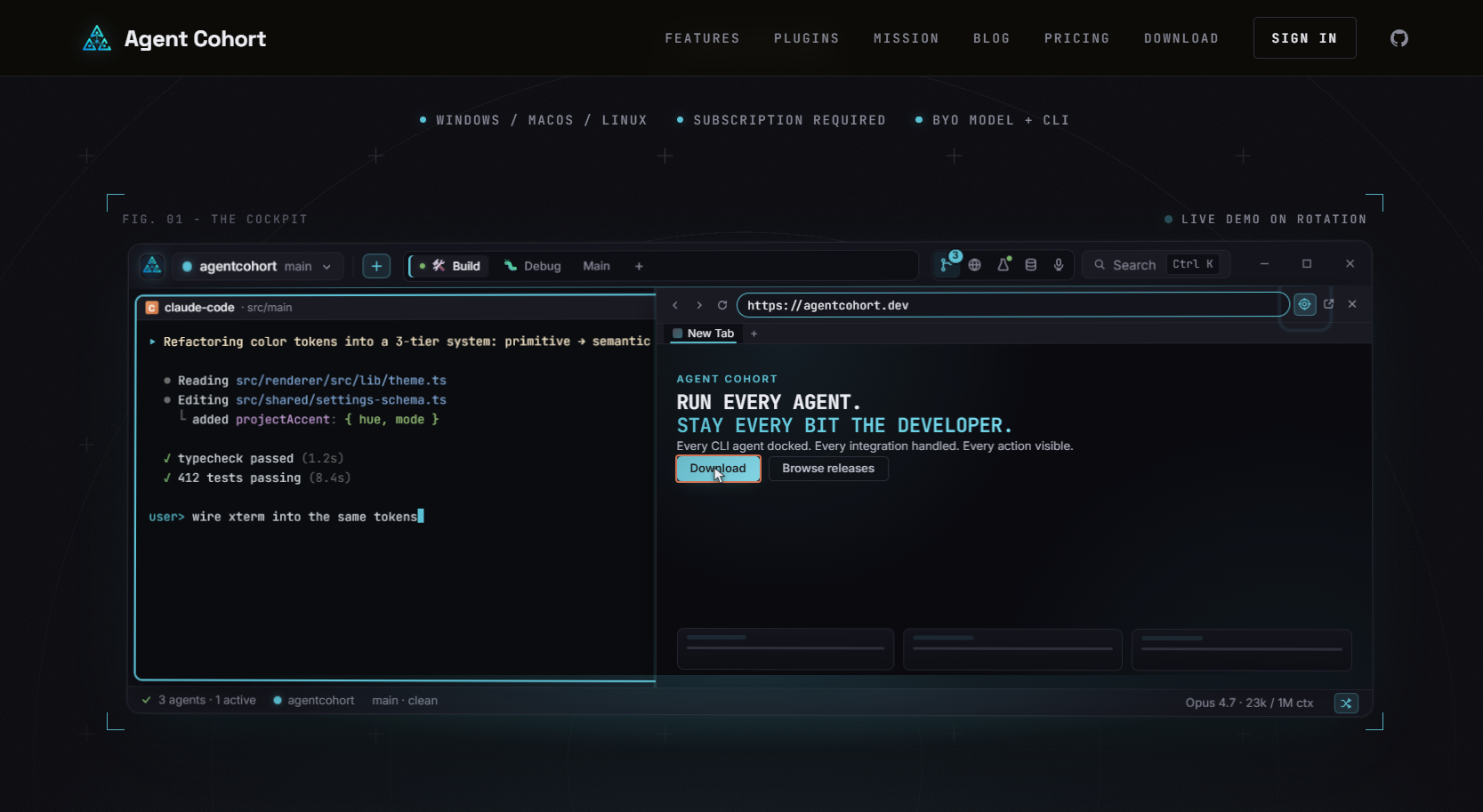
Agentcohort solves this by putting all your agents into a single multi-terminal developer workspace where each project has its own dedicated environment. Session persistence means agents do not lose context between runs. Customizable layouts let you watch multiple agents work in parallel without losing track of what each one is doing. Agentcohort also handles authentication and environment setup automatically, so your team spends time on the work that matters, not on configuration. If you are building an agentic workflow and need visibility and control in one place, Agentcohort is built for exactly that.
FAQ
What is agentic software development in simple terms?
Agentic software development is a method where AI agents autonomously handle tasks across the full software lifecycle, from planning to deployment, with developers acting as reviewers and orchestrators rather than line-by-line coders.
How does agentic development differ from GitHub Copilot-style tools?
Traditional AI coding tools suggest or complete code in isolation. Agentic systems plan, execute, test, and adapt across multiple SDLC stages without waiting for a human prompt at each step.
What are the main risks of agentic software development?
Agents can hallucinate, propagate defects, or iterate in the wrong direction without governance controls. Structural safeguards like identity management, test-before-merge protocols, and Plan-mode-default are required to manage these risks.
Which frameworks support agentic software development?
Leading frameworks in 2026 include CrewAI, LangGraph, AutoGen, Microsoft Semantic Kernel, and DSPy. Each varies in how it handles single-agent versus multi-agent orchestration.
What is the most important factor for successful agentic adoption?
Workflow redesign is the single strongest predictor of success. Layering agents onto existing processes without redesigning how work flows through the team produces minimal gains.