
title: "AI Agent Visibility Control Benefits for Enterprise Security" slug: "ai-agent-visibility-control-benefits-enterprise-security" meta_description: "Everyone's racing to deploy AI agents. Nobody's asking who's watching them. Here's what 15 years of engineering scars taught me about why visibility and control are the only things standing between you and a production disaster." author: Ben Dol tags: [AI agents, enterprise security, governance, observability, risk management, AI transparency] status: publish
The common take is that AI agents are a productivity story. Deploy them, reclaim time, ship faster. I've heard that pitch a hundred times. Here's the thesis I'll stake my reputation on: GENERATION is solved. Verification is not. Every team I've watched stumble in the last three years stumbled not because their agents couldn't act, but because nobody could see what those agents were actually doing until something broke badly.
The real benefits of AI agent visibility and control aren't about dashboards. They're about knowing, with certainty, that your agents are operating within the boundaries you set, on behalf of the users you authorized, touching only the data they're supposed to touch. That's governance. That's the thing most enterprises skip until the audit.
- Strengthened governance through real-time monitoring and audit trails that survive regulatory scrutiny
- Improved risk management by catching unauthorized agent behaviors before they cascade
- Faster incident response because your team isn't reconstructing what happened from scattered logs
- Data loss prevention enforced at the permission layer, not patched in after a breach
- Compliance readiness baked into the control plane, not bolted on before an audit
Why can't traditional security tools see what AI agents are doing?
AI agents operate with elevated privileges. They call APIs, query databases, write to external systems, and spawn subagents, often in chains that go three or four hops deep. Traditional security tooling was built for human users and static software processes. It was never designed to track an agent that delegates work to another agent, which delegates again, with the original authenticated identity narrowing at each hop rather than persisting cleanly.

The result is a visibility gap that practitioners rarely talk about honestly. Unified identity security across AI agents is now a recognized category, with Gartner naming AI Agent Security as an emerging discipline precisely because existing tools can't cover it. Without dedicated observability, you get telemetry that tells you an API was called but not why, by which agent, under whose authorization, or what it did with the result.
Control closes that gap. A proper control layer enforces policies, restricts access to least-privilege, and limits blast radius when an agent behaves unexpectedly. Visibility without control gives you a front-row seat to a disaster. Control without visibility means your policies go stale the moment agents evolve and you have no way to know it.
What do the actual security benefits look like in practice?
The fastest incident response I've seen in agentic systems comes from teams that treat AI agent observability as a first-class engineering concern. AI models correlate telemetry from logs, metrics, and traces to pinpoint issues before outages occur, cutting mean time to resolution from hours to minutes. That's not a marketing claim; it's what happens when you stop asking engineers to manually sift thousands of log lines and let the system surface the causal chain automatically.
Data exfiltration risk drops sharply when agent permissions are enforced at the control plane rather than trusted at the application layer. An agent that can only see the records relevant to its current task cannot exfiltrate what it cannot reach. That sounds obvious. Most teams don't implement it until after their first near-miss.
Governance gets real when you have a unified control plane that logs every tool call with identity provenance. Agent control planes enforce authentication, authorization, and policy rules across chained agent workflows, maintaining audit trails that say who made the request, under what authorization, and what happened. Not "api_key=sk-shared." Actual identity. That's the difference between an audit trail and a fiction.

Consider a financial services team running investment analysis agents. The control plane restricts which data sources each agent can query, logs every output for regulatory review, and blocks actions outside permitted scope. The audit trail is generated automatically, not reconstructed after the fact when a regulator asks questions.
Alert fatigue is the silent killer of security operations. Visibility without a reconciliation loop produces noisy telemetry that buries real signals under false positives. The fix is verification cycles that link AI outputs back to intended goals, filtering noise into genuinely actionable signals.
What does an effective AI visibility and control system actually contain?
Most teams build these backwards, starting with dashboards and adding governance later. The right order is:
-
Discovery and registry. Every agent, tool, and integration must be registered before it touches production. A partial registry is worse than no registry because you'll make governance decisions on an incomplete picture. Build registration into the deployment process, not as a separate step teams skip under deadline pressure.
-
Observability platform. Capture logs, metrics, and traces across every agent interaction. Use OpenTelemetry as the telemetry standard; it's what most observability platforms already consume, and proprietary formats create lock-in that hurts when you need to switch.
-
Policy enforcement system. Define which tools agents can use, what data they can access, and which actions require human approval. Retrofitting controls into a live system is significantly harder than establishing them at the start.
-
Lifecycle management. Track agent versions, updates, and configuration changes. Policies go stale as agents evolve. Lifecycle management is what keeps your rules current.
-
Identity and access management integration. Agent identity must narrow at each delegation step, not widen. Every tool call should carry provenance back to the original authenticated user.
-
Sandboxing and bounded autonomy. Sandbox environments enforce bounded autonomy by restricting agents to defined data and tool access, balancing experimentation with security. In regulated sectors like healthcare and finance, sandboxes enforce compliance boundaries directly, preventing data leaks without stifling capability.
| Component | What it governs | Why it fails without the others |
|---|---|---|
| Discovery and registry | Which agents exist and what they're authorized to do | Blind spots in the registry mean ungoverned agents run freely |
| Observability | Behavioral telemetry across all agent interactions | Telemetry without policy context produces noise, not insight |
| Policy enforcement | Permitted tools, data, and actions per agent | Policies without lifecycle management go stale as agents change |
| Lifecycle management | Versioning, updates, audit trails | Without it, you can't trace which version of an agent caused an incident |
| Identity integration | Authentication and authorization provenance | Without it, identity evaporates at the first delegation hop |
Pro Tip: Build human oversight gates specifically for irreversible actions. Requiring human approval before an agent deletes records, sends external communications, or commits financial transactions is a valid policy choice and often a regulatory one. A control plane makes those gates easy to insert and audit.
What risks does agent autonomy actually introduce, and how do you contain them?
The autonomy-control tradeoff is qualitative, not quantitative. Increasing an agent's autonomy doesn't just reduce how often humans intervene; it changes the KIND of control that's possible. A system that plans and acts across extended time horizons requires oversight that addresses its goals and reasoning, not just its outputs.
Here's where it gets uncomfortable. IBM Institute research finds that 72% of executives are already seeing a rise in unsanctioned AI use by employees. Shadow AI creates fragmented governance blind spots: each team picks its own framework, connects to its own data sources, sets its own access controls, or none. The result is duplicated effort, inconsistent behavior, and security gaps with no visibility into what's running.
Runaway API costs are a real operational risk that most governance discussions ignore. One runaway agent loop can wipe out a month's budget with no visibility into what triggered it. Per-API-key limits don't give you per-user, per-agent, or per-workflow budget control. A control plane does.
Compliance violations accumulate silently without proper audit trails. An agent generating outputs that fall outside permitted scope may do so hundreds of times before anyone notices, because nobody was watching the right telemetry.
The four mechanisms that address these risks, as surveyed in the controllability research: constraints and guardrails, adaptive control, agent-in-the-loop oversight, and human-in-the-loop review. Fixed rules establish the baseline. Adaptive control handles situations fixed rules can't anticipate. Human oversight preserves normative authority where it matters most. No single mechanism is sufficient alone.
I built something about this, and you should know I'm biased
Full disclosure: I'm the founder of Agentcohort, and everything I'm about to describe is something I built because I got burned by the problems above. Take that for what it's worth.
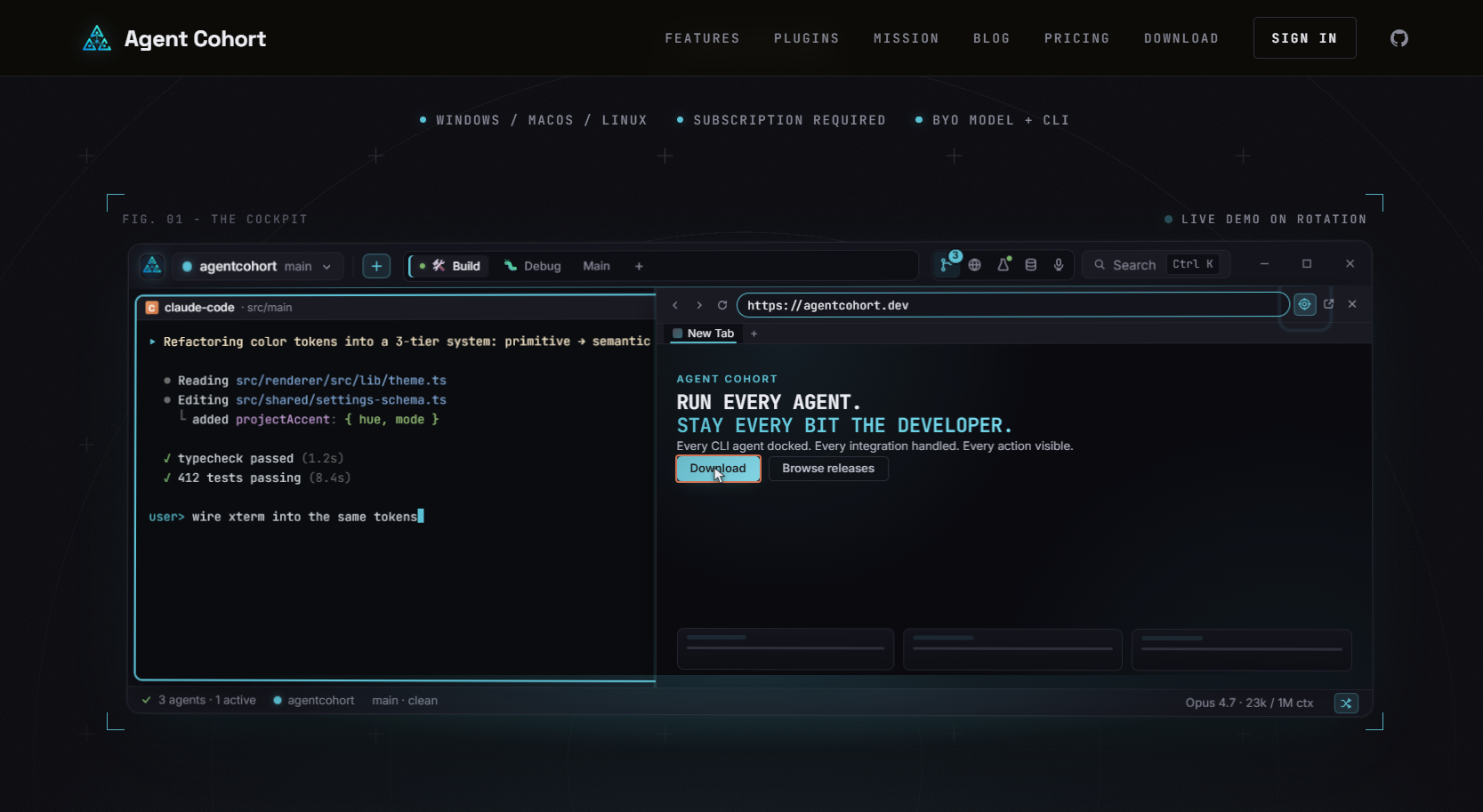
After watching too many teams run Claude Code and OpenAI Codex in fragmented terminal windows with no shared context, no audit trail, and no way to know which agent touched what, I built a unified developer command deck that puts multiple agents in a single workspace where every session is visible, every action is traceable, and every project has its own dedicated environment.
The features that came from scars: session persistence so you don't lose context mid-workflow, automatic authentication handling so agents don't share credentials, and a multi-terminal grid so you can actually SEE what each agent is doing without switching windows. None of that is glamorous. All of it matters when something goes wrong at 2 AM.
You can build this yourself. Seriously. If you have the engineering bandwidth, a control plane with OpenTelemetry, a proper registry, and sandboxed environments per project will get you most of the way there. Agentcohort is for teams that would rather ship than build infrastructure.
What exactly do "visibility" and "control" mean in an agentic context?
Visibility, in the governance sense, means information about where, why, how, and by whom AI agents are used. The ACM research on AI agent visibility identifies three core mechanisms: agent identifiers that indicate which agents are involved in an interaction, real-time monitoring that flags problematic behavior as it happens, and activity logs that enable post-hoc analysis. Together they form the information layer that makes governance possible.
Control is the enforcement layer built on top of that information. It includes the policies, permission systems, sandboxes, and human oversight gates that translate visibility into actual constraints on agent behavior. Visibility without control is observation. Control without visibility is guesswork. The scope of both expands as agents become more autonomous and operate across more systems.
How does visibility help you meet regulatory requirements?
Regulatory frameworks like HIPAA, SOC 2, and financial services compliance rules share a common requirement: you must be able to demonstrate what happened, when, and under whose authority. An agent control plane generates that audit trail automatically, at every delegation step, with identity provenance attached. That's not a nice-to-have for regulated industries; it's the difference between passing an audit and failing one.
Permission-aware AI governance frameworks tie agent actions directly to authorization records, so compliance evidence is produced as a byproduct of normal operations rather than reconstructed under pressure. Sandboxing in healthcare keeps code execution within HIPAA-compliant boundaries. In financial services, the control plane restricts data sources and logs every output for regulatory review.
MIT Sloan research notes that agentic AI can reclaim about 20% of staff time, but that figure is routinely misread as a direct labor cost reduction. Regulatory bodies care about outcomes and accountability, not efficiency claims. Visibility is what lets you prove the former.
What are the real drawbacks of implementing these systems, and how do you manage them?
The honest answer: visibility and control systems add operational overhead, and that overhead is real. Telemetry pipelines consume compute. Registries require maintenance. Human oversight gates slow down workflows that were designed to be autonomous. If you instrument everything at maximum detail, you'll generate more data than your team can analyze, which is how you end up with alert fatigue instead of insight.
The mitigation is calibration. Log at the level of detail the risk profile demands. High-risk, irreversible actions warrant fine-grained logging. Routine read operations may not. Adaptive control mechanisms handle edge cases that fixed rules miss, but they require ongoing tuning. Human-in-the-loop architectures preserve normative authority but face scalability and cognitive load challenges, so reserve them for the actions that genuinely warrant human judgment.
Privacy is a real concern too. Detailed activity logs capture sensitive data about user interactions and business processes. Governance of the governance system matters: who has access to the telemetry, how long it's retained, and under what conditions it can be reviewed.
Start narrow. Govern your highest-risk agents first. Expand the control plane as you learn what your specific environment actually needs.
Key Takeaways
Effective AI agent governance requires visibility and control working together: visibility provides the audit trail, control enforces the boundaries that make that trail meaningful.
| Point | Details |
|---|---|
| Visibility enables real governance | Agent identifiers, real-time monitoring, and activity logs form the information layer that makes oversight possible. |
| Control planes enforce identity at every hop | Authentication and authorization must narrow at each delegation step, not evaporate after the first. |
| Shadow AI is already a majority problem | 72% of executives report rising unsanctioned AI use, making centralized discovery a priority, not a future project. |
| Fixed rules are a baseline, not a solution | Adaptive control and human oversight remain necessary because constraints alone cannot anticipate every edge case. |
| Calibrate logging to risk level | Maximum telemetry detail on every action creates alert fatigue; match logging depth to the actual risk profile of each agent action. |
The agents that will cause your next production incident aren't the ones you're watching. They're the ones you forgot to register.