
Continuous workflow integration is defined as the practice of frequently merging code changes into a shared repository, triggering automated builds and tests with every commit. Known in the industry as Continuous Integration (CI), this approach catches defects early, reduces merge conflicts, and keeps a deployable codebase at all times. For developers and project managers working under Scrum Alliance and GitHub standard practices, CI is the backbone of modern software delivery. Understanding what is continuous workflow integration means understanding how automation and team discipline combine to produce faster, more reliable releases.
What is continuous workflow integration and how does it work?
Continuous Integration is a core development practice where developers merge code into a shared repository multiple times a day. Each merge triggers an automated pipeline that builds, tests, and reports results back to the team. The goal is to surface problems within minutes, not days.
A typical CI pipeline follows these stages in order:
- Code commit. A developer pushes changes to version control, such as Git. This commit is the trigger for everything that follows.
- Automated build. The pipeline compiles the code and packages it. A failed build alerts the team immediately.
- Unit testing. Automated unit tests run against the new code. These tests verify that individual functions behave as expected.
- Static analysis. Tools scan the code for style violations, security issues, and complexity problems without executing it.
- Integration testing. The system tests how the new code interacts with other components. This phase catches interface and dependency issues.
- Notification. The pipeline sends alerts on failures via email, Slack, or a dashboard. Developers fix the issue before moving on.
Trunk-based development is the branching strategy that makes CI work. Teams commit directly to the main branch, or merge short-lived feature branches within a day or two. Long-lived branches defeat the purpose of CI because they delay integration and allow conflicts to accumulate.
Pro Tip: Keep your build time under ten minutes. A slow build discourages frequent commits, which breaks the feedback loop that makes CI valuable.

What are the benefits of continuous workflow integration for teams?
Frequent integration directly reduces the number of merge conflicts a team faces. When every developer merges daily, the differences between branches stay small and manageable.
The benefits extend well beyond conflict reduction:
- Faster feedback cycles. Automated tests run within minutes of a commit. Developers learn about bugs while the code is still fresh in their minds.
- Higher code quality. Automation accelerates feedback loops and supports agile and DevOps methods for predictable software releases. Consistent test coverage prevents regressions from slipping through.
- Parallel development. CI allows developers to work independently in parallel and merge efficiently, scaling engineering team output without creating bottlenecks.
- Predictable delivery. Project managers gain visibility into build status and test results at any moment. This makes sprint planning and release scheduling far more accurate.
- Reduced integration risk. Small, frequent merges mean that when something breaks, the cause is easy to identify. Large, infrequent merges create "merge hell," where multiple changes interact in unpredictable ways.
CI also supports automation in localization and other downstream processes by ensuring the codebase is always in a known, tested state. When the main branch is always deployable, teams can trigger additional automated workflows with confidence.
The cultural shift matters as much as the tooling. Teams that commit frequently build a habit of writing smaller, more focused changes. That discipline compounds over time, producing cleaner architecture and fewer production incidents.
How does continuous workflow integration differ from general workflow automation?
Workflow automation and CI are related but distinct. Workflow automation broadly manages end-to-end business processes using triggers and actions across multiple systems and teams. CI is a technical subset focused specifically on code integration reliability.
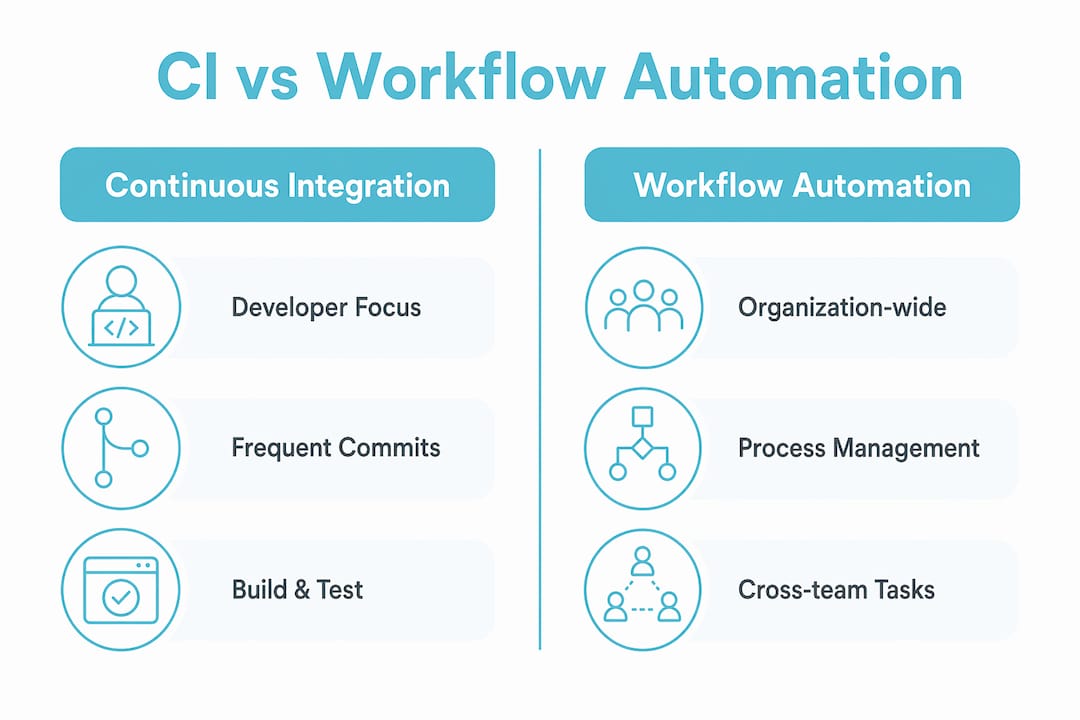
The table below shows where they overlap and where they diverge.
| Dimension | Continuous Integration | Workflow automation |
|---|---|---|
| Primary audience | Software developers | Operations, HR, finance, and IT teams |
| Core trigger | Code commit to version control | Business event or scheduled task |
| Output | Tested, deployable code artifact | Completed business process or data record |
| Tooling focus | Build servers, test runners, version control | Process orchestrators, API connectors, RPA tools |
| Feedback speed | Minutes | Minutes to hours depending on process |
CI lives inside the software development lifecycle. Workflow automation lives across the organization. A finance team uses workflow automation to route invoices for approval. A development team uses CI to verify that a new payment feature does not break existing checkout logic. The two practices complement each other when combined: a passing CI build can trigger a broader workflow automation process that deploys the artifact, notifies stakeholders, and updates project tracking systems.
Pro Tip: Treat CI as the quality gate and workflow automation as the delivery conveyor. Connect them with webhooks or event-driven triggers to get the benefits of both without duplicating effort.
What are common challenges and best practices for implementing CI effectively?
The biggest challenge in CI adoption is cultural, not technical. A successful CI practice requires a cultural discipline of frequent merges along with automated testing. Automation alone is insufficient. Developers who are used to working in isolation for days or weeks resist the habit of committing multiple times a day.
Technical hurdles compound the cultural ones:
- Test suite investment. Automated testing frameworks require upfront investment in writing tests and configuring environments, which can delay initial CI benefits. Teams often underestimate how long it takes to build reliable test coverage.
- Long-lived branches. Long-lived feature branches delay integration and reduce CI effectiveness. Teams should adopt trunk-based development to keep the main codebase stable and deployable.
- Flaky tests. Tests that pass and fail unpredictably erode trust in the pipeline. Developers start ignoring failures, which defeats the purpose of automation.
- Build speed creep. As test suites grow, build times increase. A pipeline that once ran in five minutes can balloon to thirty, discouraging frequent commits.
The most reliable path to successful CI adoption is phased. Phased adoption of CI, starting with source control discipline, is the most common expert recommendation to avoid burnout and maximize automation impact. Start with version control hygiene. Then automate the build. Then add unit tests. Then add integration tests. Each phase delivers value before the next one begins.
"True continuous integration requires both frequent commits multiple times a day and a reliable automated testing environment. Without these, automated builds alone do not prevent merge conflicts." — Atlassian
Avoiding automation fatigue means keeping the pipeline fast and the feedback clear. Delete tests that are consistently flaky rather than letting them pollute the results. Parallelize test execution to keep total build time under ten minutes. Assign ownership of the pipeline to a specific team member so it does not decay through neglect.
Key Takeaways
Continuous Integration succeeds when frequent commits, fast automated feedback, and trunk-based development work together as a disciplined team practice, not just a tooling choice.
| Point | Details |
|---|---|
| CI is defined by frequency | Merging code multiple times a day is what separates true CI from occasional automated builds. |
| Trunk-based development is required | Long-lived branches undermine CI pipelines; keep feature branches short and merge them daily. |
| Culture drives adoption | Tooling without commit discipline fails; teams must build the habit of frequent, small merges. |
| Phased implementation works best | Start with version control, then automate builds, then add tests to avoid burnout and pipeline failures. |
| CI and workflow automation complement each other | CI handles code quality; broader workflow automation handles delivery, notifications, and business processes. |
Why build speed is the metric most teams ignore
Most CI conversations focus on test coverage and tooling choices. The metric that actually determines whether a team uses CI correctly is build speed. The speed of the build-feedback loop determines developer integration behavior. Slow builds discourage frequent commits, which harms CI effectiveness.
I have watched teams invest months in writing comprehensive test suites, only to end up with a 45-minute build that nobody trusts. Developers stop committing frequently. The pipeline becomes a formality rather than a feedback tool. The whole point of CI collapses.
The uncomfortable truth is that a fast, incomplete test suite beats a slow, thorough one in the short term. You can always add tests. You cannot easily recover a team that has lost the habit of frequent integration. Start with the tests that run in under a second and cover the most critical paths. Protect build speed as aggressively as you protect code coverage.
CI is also often misunderstood as mere test automation. Its core value lies in the cultural practice of frequent, small merges. The automation is the mechanism. The discipline is the product. Teams that get this right ship faster, debug faster, and collaborate better than teams that treat CI as a checkbox on a DevOps maturity model.
— Ben
How Agentcohort supports your CI workflow
Agentcohort is built for development teams who want to run multiple AI agents across projects without losing control of their environment.
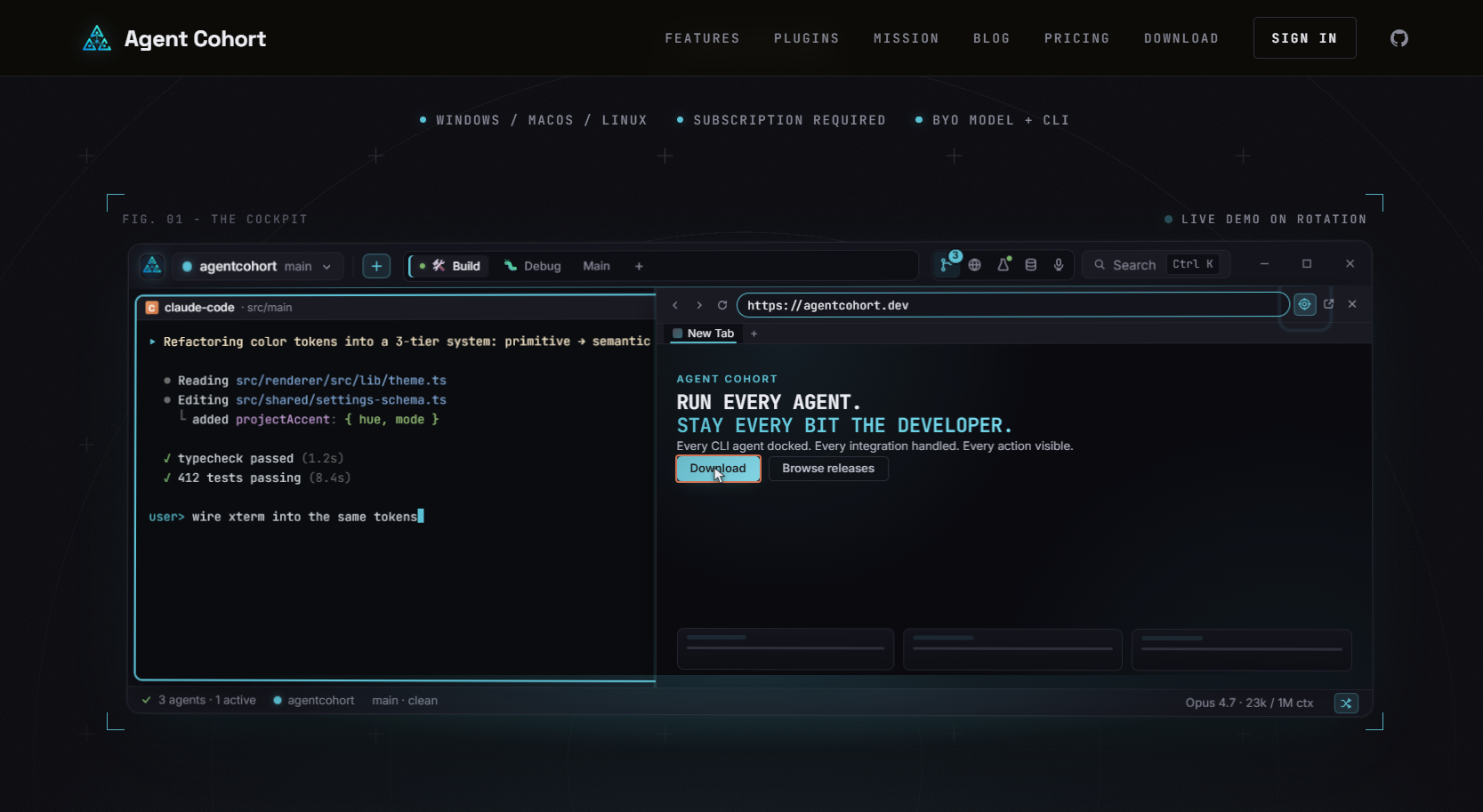
The Agentcohort platform provides a multi-terminal grid where each project gets its own dedicated workspace, with Claude Code and OpenAI Codex running side by side. Session persistence means your context survives restarts. Automatic setup handling covers installations and authentication so your team spends time on code, not configuration. For teams building out CI practices, Agentcohort keeps every agent's actions visible and auditable, which is exactly the kind of control you need when automation is doing real work on your codebase.
FAQ
What is continuous workflow integration in simple terms?
Continuous workflow integration, formally called Continuous Integration (CI), is the practice of merging code changes into a shared repository multiple times a day and running automated builds and tests on each merge. The goal is to catch bugs early and keep the codebase always deployable.
How does a CI pipeline differ from a CD pipeline?
A CI pipeline covers the build, test, and release preparation stages. A continuous delivery (CD) pipeline extends CI by automating the deployment of tested code to staging or production environments, completing the full delivery workflow.
Why do long-lived branches break CI?
Long-lived branches accumulate changes that diverge from the main codebase. When they finally merge, the differences are large and conflicts are hard to resolve. Trunk-based development, with short-lived branches merged daily, keeps integration manageable.
What is the first step to implementing CI on a team?
The first step is establishing version control discipline. Every developer must commit to a shared repository consistently before any build or test automation adds value. Phased adoption starting with source control is the most widely recommended approach.
How does CI support agile and DevOps practices?
CI aligns directly with agile sprint cycles by providing continuous feedback on code quality throughout each iteration. In DevOps, CI is the foundational quality gate that feeds into automated delivery pipelines, enabling teams to release frequently and with confidence.