
AI agents support MVP development by acting as specialized autonomous collaborators that execute research, architecture, coding, testing, and deployment, each stopping at human-verified checkpoints to maintain quality and alignment. The industry term for this approach is agentic software development, and it is reshaping how product teams ship. Multi-agent systems compress traditional 8-week build cycles to 7–21 days, with fixed-price delivery starting around $8,000. That compression is not magic. It is the result of role specialization, structured handoffs, and disciplined human oversight at every critical gate. This article explains how AI agents support MVP development phase by phase, where human control is non-negotiable, and what architectural choices separate fast MVPs from fragile ones.
How do AI agents support MVP development across phases?
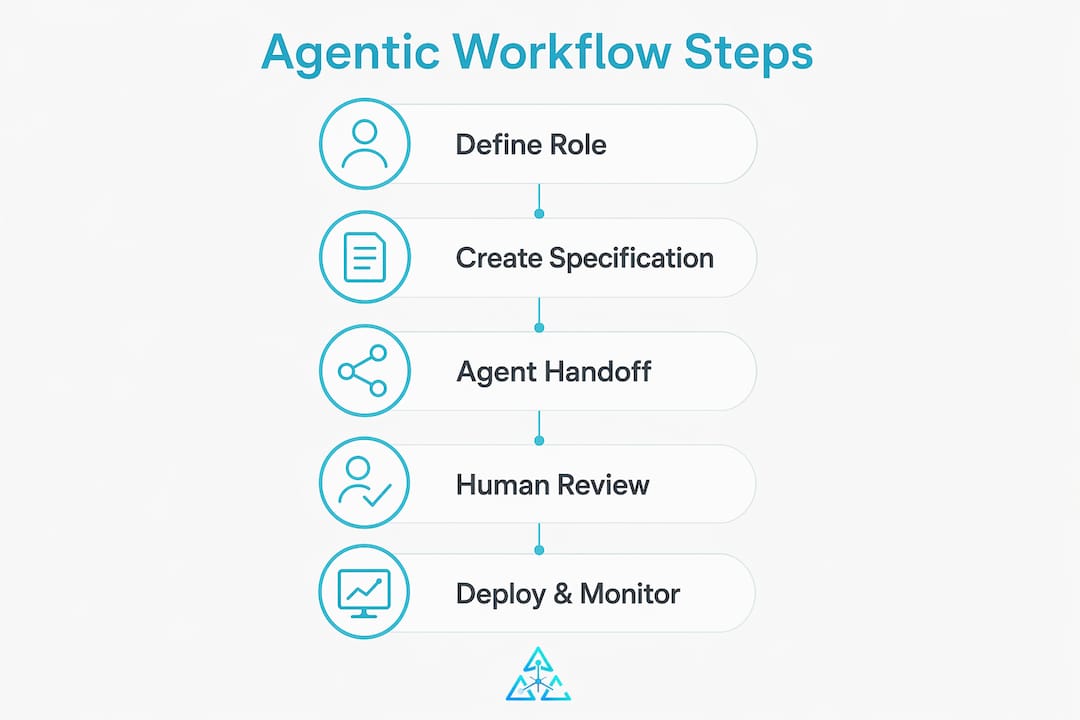
The common mistake is treating AI agents like a faster keyboard. They are not. Specialized AI agents constrained to roles like PM, Architect, Developer, QA, and Deployer produce higher quality, traceable outputs than generalist AI. Each agent has a defined mandate, a set of inputs, and a required output artifact before the next agent picks up the work.
Here is what that looks like in practice:
- Research agent: Scans market data, competitor positioning, and user interview transcripts. Outputs a structured brief with validated assumptions.
- Architecture agent: Converts the brief into a system design document, selecting data models, API contracts, and technology stack choices.
- Developer agent: Implements features layer by layer against the architecture spec, writing tests alongside code.
- QA agent: Runs the test suite, flags regressions, and produces a coverage report.
- Deployer agent: Prepares environment configs, runs pre-flight checks, and stages the build for human sign-off.
Role separation prevents context dilution and enables excellence compared to general-purpose agents. When one agent tries to do everything, it loses the thread between business intent and implementation detail. Typed handoff documents with explicit schemas keep architectural decisions intact as they move between agents. That is the difference between a system that ships and one that quietly drifts.
Teams using multi-agent orchestration witness 40% fewer deployment-related issues versus teams using isolated AI coding assistants. That number reflects what happens when you replace ad hoc prompting with a governed pipeline.
Pro Tip: Write a one-page agent brief for each role before you start. Define the input format, the output artifact, and the stop condition. Agents without stop conditions run forever and produce garbage.
Why human oversight is the immune system of AI-augmented MVPs
Generation is solved. VERIFICATION is not. That is the thesis I keep coming back to after years of watching teams ship AI-generated code they do not fully understand.
Human-in-the-loop review must happen twice before merging AI-generated code related to user data, authentication, or payments. One review catches obvious errors. The second review catches the subtle ones, the kind that only surface when you read the code a second time with fresh eyes. Weekly architectural sanity checks function as a forcing function to ask whether the system still makes sense as a whole.
A structured checkpoint workflow looks like this:
- Spec review: A human approves the architecture document before any code is written. No spec, no code.
- Module review: AI-generated code for auth, payments, and user data gets two separate human reads before merging.
- Integration review: A human verifies that agent-produced components connect correctly at the seams.
- Pre-deploy review: A human signs off on environment configs and migration scripts before any production push.
- Weekly sanity check: The team reads the full system diagram and asks whether the architecture still reflects the product intent.
Treating every AI agent artifact as a formal checkpoint requiring human approval prevents agents from rubber-stamping their own work. Structured human checkpoints create visibility and maintain quality across agent-produced specs, code, and tests. Without this discipline, you are not building an MVP. You are accumulating technical debt at machine speed.
Pro Tip: Never let an agent review its own output. Assign a separate agent or a human to every verification step. Self-review is how silent failures compound.
What architecture choices make agentic workflows actually work?
Most teams get the agents right and the repository wrong. A poorly structured codebase is the fastest way to turn a capable AI agent into a confused one.
Well-structured repositories and instruction files act as the agent's operating manual. Files like CLAUDE.md encode conventions, gotchas, and checklists that agents follow automatically. Without them, every agent session starts from scratch, and you spend half your time correcting the same mistakes.
The table below contrasts two common approaches to agentic repository design:
| Approach | What it looks like | What happens |
|---|---|---|
| Unstructured repo | No instruction files, mixed conventions, implicit context | Agent drifts, repeats errors, requires constant correction |
| Structured repo | Explicit CLAUDE.md, clear folder conventions, typed schemas | Agent follows rules, produces consistent artifacts, scales across sessions |
Specification-level prompts outperform keystroke commands by a wide margin. Telling an agent "implement the login flow" produces worse results than handing it a two-page spec with data models, error states, and acceptance criteria. Engineers become system architects directing autonomous agents rather than typing syntax line by line. That shift requires a different skill set, and most teams underestimate it.
Building an evaluation harness with 30–50 real-world input/output pairs is the single most underrated practice in agentic MVP development. Regression test suites capture edge cases and prevent silent failures in later builds. AI outputs are probabilistic. Without a harness, you cannot tell whether a change improved the system or quietly broke something three layers down.
Key architectural practices that separate working agentic MVPs from broken ones:
- Write instruction files before writing any code.
- Use explicit schemas for every agent handoff document.
- Build the evaluation harness in parallel with the first feature, not after.
- Run multi-file, multi-phase workflows with full execution loops: code, test, deploy.
- Treat every agent output as a draft, not a final artifact.
What are the real benefits and pitfalls of AI agents in MVP builds?
The numbers are real, but the context matters. Organizations using specialized AI agent studios achieve production-grade MVPs in 2–3 weeks at a fixed price. That is a genuine compression of the traditional timeline. The catch is that it requires a team that already knows how to write specifications, review code, and govern a pipeline.
The pitfall that kills most AI-assisted MVPs is what practitioners call "vibe coding." A developer prompts an agent, accepts the output without reading it, prompts again, and ships. The result looks functional in a demo and collapses under real user load. Agentic development demands precise specification writing, architectural discipline, and reading far more code than writing. Speed without understanding is just faster debt accumulation.
Another common failure: teams spend budget on custom fine-tuned models before validating the product. Most MVPs use hosted frontier models like GPT-4 or Claude, and fine-tuning is a post-validation step. Premature fine-tuning burns runway on a product that may pivot or fail.
Practical starting points for teams new to agentic development:
- Identify the single biggest friction point in your current build process and assign one agent to it.
- Run a two-week pilot with a structured repo and explicit checkpoints before scaling to a full pipeline.
- Measure deployment incident rate before and after introducing multi-agent orchestration.
- Resist adding agents until the existing ones produce consistent, reviewable artifacts.
The shift from point AI tools to integrated multi-agent platforms is where leading organizations are moving. The teams that get there first will not be the ones who adopted AI fastest. They will be the ones who governed it best.
Key Takeaways
AI agents support MVP development most effectively when role specialization, structured handoffs, and human checkpoints work together as a governed system, not as isolated automation.
| Point | Details |
|---|---|
| Role specialization matters | Assign each agent a defined mandate and output artifact to prevent context drift. |
| Human checkpoints are non-negotiable | Double-review auth, payments, and user data modules before merging any AI-generated code. |
| Repository structure drives agent quality | Instruction files like CLAUDE.md encode conventions agents follow across every session. |
| Evaluation harnesses prevent silent failures | Build 30–50 real-world test cases in parallel with your first feature, not after shipping. |
| Vibe coding creates fast technical debt | Accepting agent output without reading it compounds architectural problems at machine speed. |
Generation is solved. Verification is the job now.
I have shipped enough AI-assisted products to know that the hype cycle gets the causality backwards. Teams celebrate how fast agents generate code. Nobody celebrates how carefully they verified it. That asymmetry is where MVPs die.
The teams I have watched succeed with agentic development share one trait: they treat specification writing as the primary engineering skill. Not prompting. Not model selection. Writing a spec so clear that an agent cannot misinterpret it. That discipline is harder than it sounds, and most engineers resist it because it feels slow. It is not slow. It is the work that makes everything else fast.
I built Agentcohort because I kept running into the same problem: teams had capable agents and broken pipelines. The agents were fine. The governance was missing. I am biased, obviously. But the scars are real, and they shaped every feature we built. If you want to do this without a platform, you can. You need a structured repo, explicit schemas, a harness, and a checkpoint protocol. That is the minimum. Everything else is acceleration.
The quotable version: Speed is what agents give you. Discipline is what you bring.
— Ben
What Agentcohort does for teams building MVPs with AI
Product teams that want to move from scattered agent experiments to a governed pipeline have one core problem: visibility. You cannot govern what you cannot see.
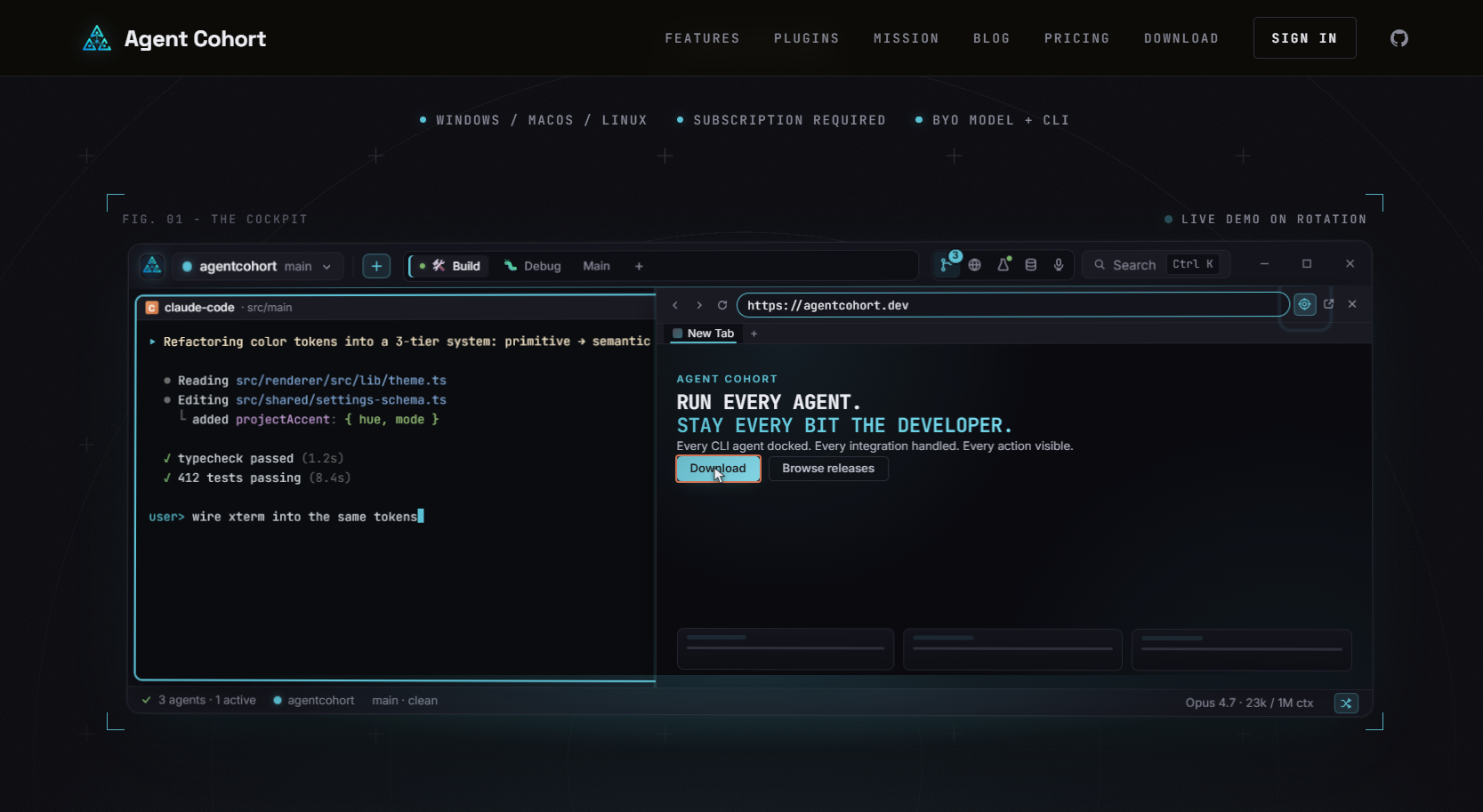
Agentcohort is a multi-agent developer workspace that integrates Claude Code, OpenAI Codex, and other agents into a single terminal grid. Each project gets its own dedicated environment with session persistence, so context does not evaporate between runs. Checkpoints, layouts, and agent assignments are configurable. Setup, authentication, and environment scaffolding happen automatically, so teams spend time on the product, not the plumbing. If the ideas in this article resonate, Agentcohort is where they become a repeatable workflow.
FAQ
How do AI agents reduce MVP development time?
Multi-agent systems compress traditional 8-week cycles to 7–21 days by running specialized agents across research, architecture, development, and deployment in a governed pipeline. The time savings come from parallel execution and elimination of context-switching between tools.
What is human-in-the-loop review in agentic MVP development?
Human-in-the-loop review means a human approves every agent-produced artifact before the next phase begins. Double human validation is required for modules handling auth, payments, and user data.
What is vibe coding and why is it dangerous for MVPs?
Vibe coding is the practice of accepting AI-generated code without reading or reviewing it. It produces demos that look functional but accumulate architectural debt that surfaces under real user load.
Do MVPs need custom fine-tuned AI models?
No. Most production MVPs use hosted frontier models like GPT-4 or Claude. Fine-tuning is a post-validation step, not a prerequisite for shipping.
What is the most important file in an agentic repository?
The instruction file, such as CLAUDE.md, is the most important file. It encodes conventions, gotchas, and checklists that agents follow automatically across every session, preventing repeated errors and context loss.