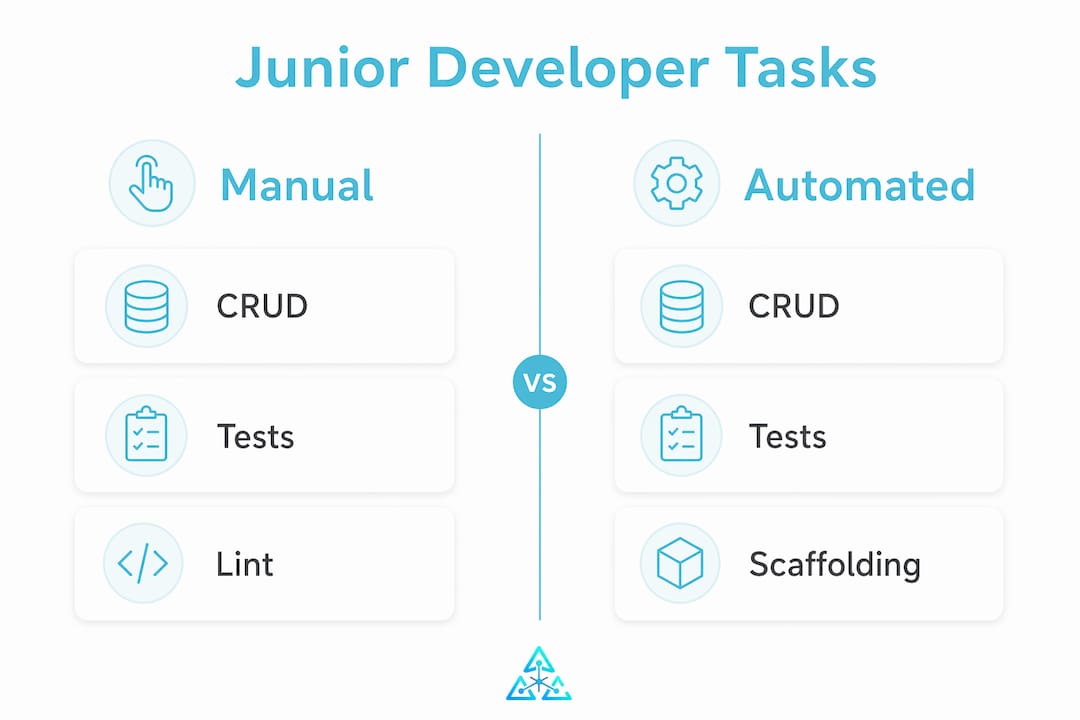
AI tools now handle the majority of tasks that junior developers spent their first two years performing. Automated coding agents complete CRUD endpoints, unit tests, lint fixes, and boilerplate scaffolding in 20–30 minutes, work that once took a junior developer most of a day. 70% of developers report that AI coding tools give them a professional advantage by shifting effort from boilerplate to complex problem-solving. That number tells you the mechanical layer of software development is effectively gone. What remains is judgment, ownership, and the ability to ask the right questions. Understanding how AI tools replace junior developer tasks is not a threat assessment. It is a map of where the work actually lives now.
How AI tools replace junior developer tasks: what's automated in 2026
The industry term for this shift is AI-augmented development, and it covers a specific, well-defined set of task categories. These are not vague productivity gains. They are concrete job functions that used to appear on junior developer job descriptions.
Routine junior tasks now automated by AI agents include:
- CRUD endpoint generation: REST and GraphQL endpoints built from a schema definition in minutes.
- Unit and integration tests: AI agents write test suites from function signatures with near-complete coverage.
- Lint and formatting fixes: Static analysis errors resolved automatically before a pull request opens.
- Dependency updates: Package version bumps with compatibility checks handled without human input.
- Boilerplate scaffolding: Project structure, config files, and environment setup generated from a single prompt.
- SQL generation: Query construction from natural language descriptions of data requirements.
- Documentation updates: Docstrings, README sections, and API references kept in sync with code changes.
The speed difference is not marginal. Tasks that took a junior developer four to eight hours now complete in 20–30 minutes. That compression changes the economics of hiring a junior for mechanical work entirely.
| Task category | Previous time (junior) | AI-assisted time |
|---|---|---|
| CRUD endpoint generation | 4–6 hours | 20–30 minutes |
| Unit test suite | 3–5 hours | 15–25 minutes |
| Dependency update pass | 2–4 hours | 10–20 minutes |
| Boilerplate scaffolding | 1–3 hours | 5–15 minutes |
Autonomous coding agents can independently process repetitive tickets end-to-end and submit pull requests for human review. Docusign built an internal coding agent that handled small, repetitive tasks with high accuracy, removing the need for a human to touch the work at all until review. That is not a prototype. That is production.
Pro Tip: Audit your team's last 30 tickets. Classify each as "mechanical" or "judgment-required." The mechanical ones are candidates for agent automation today, not next quarter.
What AI still cannot do for a junior developer
Generation is solved. VERIFICATION is not. That is the thesis, and it holds up under pressure.
AI tools handle prompts literally. They do not understand business context, and they do not ask clarifying questions. A junior developer who notices that a feature request contradicts last quarter's compliance requirement catches something the AI will never flag. That catch is worth more than a hundred generated endpoints.
The human skills AI cannot replicate include:
- Requirement clarification: Asking "what does success look like for this feature?" before writing a line of code.
- Edge case intuition: Recognizing that a payment flow needs to handle a zero-dollar transaction even when the spec does not mention it.
- Stakeholder navigation: Knowing when to escalate, when to push back, and when to just ship.
- End-to-end ownership: Monitoring a feature after deployment, responding to incidents, and understanding why something broke at 2 AM.
- Codebase history: Understanding why a particular architectural decision was made three years ago and why reversing it would cause problems.
"AI cannot replace the human side of engineering: stakeholder navigation, cross-team judgment, and contextual understanding remain essential to software delivery."
The junior developer who learns to ask good questions, document decisions, and own outcomes is building skills that compound. The one who treats AI as a replacement for thinking is building nothing.
How does AI automation affect junior developer career progression?
The traditional career ladder in software engineering relied on a specific mechanism: juniors did repetitive work, absorbed the codebase through that work, and gradually earned trust for more complex tasks. AI removes much of that apprenticeship layer. The repetitive work that integrated juniors into a team and codebase now belongs to agents.
This creates a real problem. The path from junior to mid-level engineer used to run through hundreds of small, concrete tasks. Those tasks are gone. What replaces them?
The answer is a different kind of work, and a different kind of portfolio. Here is how career progression is adapting in 2026:
- AI fluency as a baseline requirement. Hiring rubrics now emphasize AI tool proficiency and decision-making ability. Knowing how to prompt, evaluate, and correct an AI agent is a first-round interview skill, not a bonus.
- Agent orchestration over syntax. Senior teams prioritize defining tasks, evaluating AI output, and identifying failures over writing code line by line. Juniors who learn this early move faster.
- Architectural decision documentation. Teams now maintain "decisions/" repositories where architectural reasoning is recorded. Contributing to that record builds judgment faster than fixing lint errors ever did.
- Mentorship restructuring. Engineering managers are redesigning onboarding to include explicit feedback loops on AI output review, not just code review. The apprenticeship still exists. It just looks different.
- Portfolio built on judgment calls. A junior who can explain why they rejected an AI-generated solution, what the tradeoff was, and what they shipped instead has a stronger portfolio than one who shows a hundred generated endpoints.
Pro Tip: If you are a junior developer, start a "decisions/" folder in every project you touch. Write one paragraph per significant choice you made or questioned. That folder is your proof of judgment, and it compounds faster than any GitHub contribution graph.
The impact of AI on junior roles is not elimination. It is compression. The bar to demonstrate value moved up, and the timeline to demonstrate it shortened. Teams that understand this restructure mentorship intentionally. Teams that do not lose their junior pipeline within two years.
How do teams integrate AI tools without losing code quality?
The failure mode I see most often is not that AI writes bad code. It is that teams skip the governance layer entirely and discover the problem in production. Teams fail when they skip governance phases. Trusted automation requires independent validation and evidence of agent work.
Successful AI integration requires standardized tooling, human review, independent checks, and clear escalation paths. The Salesforce Agent Coding Maturity Curve describes nine stages from code generation to trusted automation. Most teams operate at stage two or three and call it done. That is where the quality problems live.
The comparison below shows how immature and mature AI integration differ in practice:
| Practice area | Immature integration | Mature integration |
|---|---|---|
| Code review | AI output merged with light review | Senior review of every AI pull request |
| Testing | AI writes tests, no independent check | Automated test suite runs independently |
| Scope control | Agent accesses full codebase | Agent restricted to specific files and modules |
| Escalation | No defined path | Clear handoff criteria to human engineers |
| Evidence | No record of agent decisions | Proof-of-work log for every agent task |
Environment-aware AI agents that access logs, container states, and limit file scopes prevent code bloat and security risks. Restricting an agent to specific files is not a limitation. It is the difference between a tool and a liability.
The validation and escalation layer is where most teams underinvest. Human-in-the-loop strategies assign agents tasks with automated testing and pull request submission for senior review. That loop, automated testing followed by human judgment, is the architecture of safe AI integration. Without it, you are not using AI. You are hoping.
Key Takeaways
AI tools automate the mechanical layer of software development, but human judgment, ownership, and communication remain the core of what junior developers must build toward.
| Point | Details |
|---|---|
| Mechanical tasks are automated | CRUD, tests, lint, and scaffolding now complete in 20–30 minutes with AI agents. |
| Judgment cannot be automated | Requirement clarification, edge case intuition, and stakeholder navigation remain human work. |
| Career bar has risen | Junior developers must demonstrate AI fluency, decision-making, and agent orchestration skills. |
| Governance prevents failure | Teams need independent validation, scope limits, and escalation paths to maintain code quality. |
| Apprenticeship must be redesigned | Mentorship now centers on AI output review and architectural judgment, not repetitive coding tasks. |
The apprenticeship died. What do we build instead?
I have been writing software for 15 years. I learned by doing the boring work. I wrote the CRUD endpoints. I fixed the lint errors. I updated the dependencies on a Friday afternoon and broke staging and learned why you never do that. That repetitive work was not just busywork. It was how I absorbed the codebase, the team's habits, and the cost of carelessness.
AI took that away. I am not sentimental about it. The endpoints are better when the agent writes them. But I am honest about what we lost: the low-stakes environment where a junior could make a mistake, feel the consequence, and grow. That environment is gone, and most teams have not replaced it with anything.
The teams I respect most right now are the ones treating agent orchestration as a teachable skill. They sit with their juniors and walk through AI output together. They ask: "What did the agent get wrong here? Why? What would you have caught that it missed?" That conversation is the new apprenticeship. It is harder to structure than "go fix these ten tickets," but it builds better engineers faster.
My honest take: the future of junior developers is not in doubt. It is in the quality of the mentorship they receive in a world where the mechanical work is gone. The engineers who thrive will be the ones who learned to verify, question, and own, not the ones who learned to generate.
— Ben
Agentcohort: a command deck for teams running AI agents
Building the governance layer from scratch is where most teams stall. You know you need scope limits, pull request review workflows, and session persistence across agents. You also know that stitching those together from individual tools takes weeks you do not have.
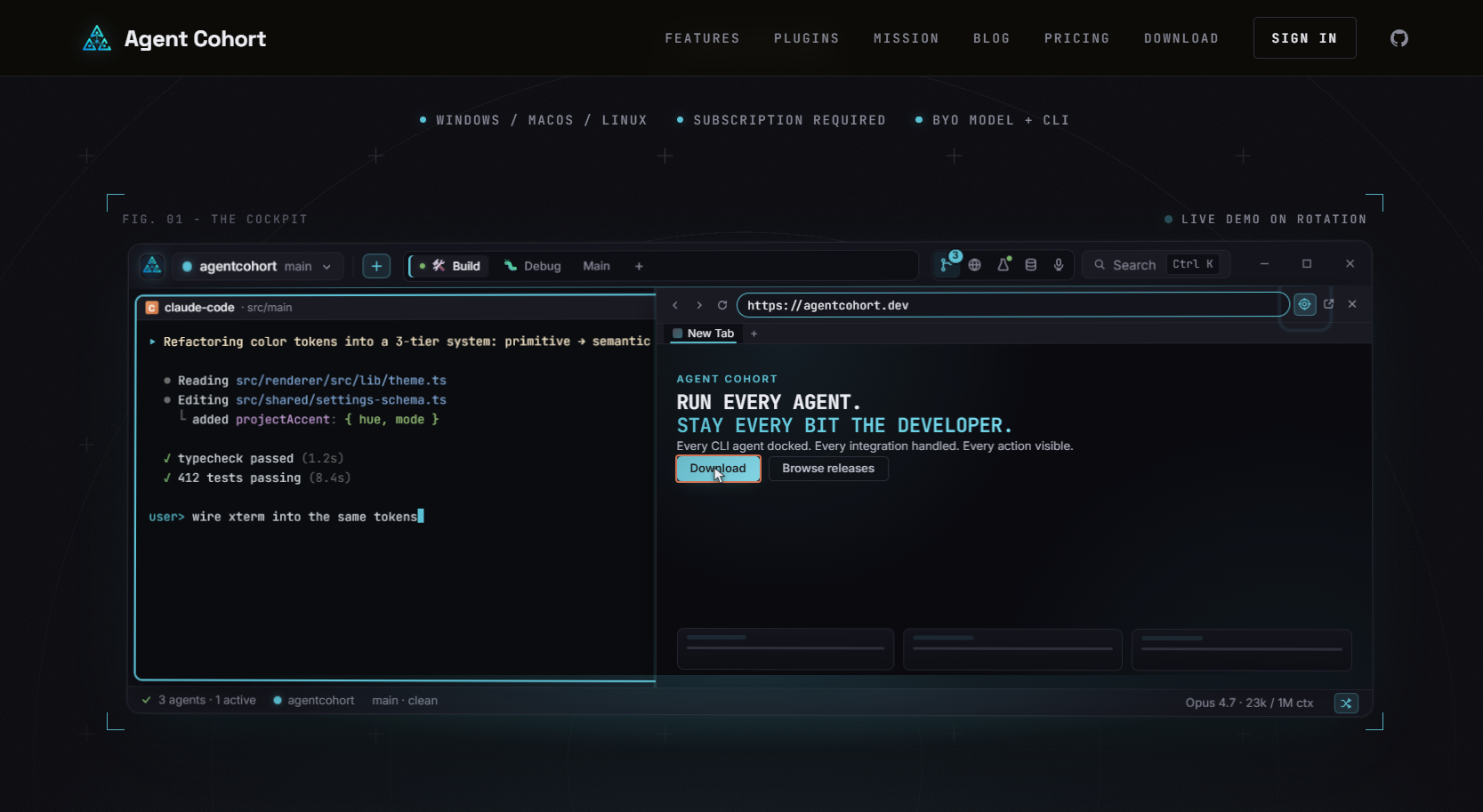
Agentcohort is the developer command deck I built from those exact scars. It integrates Claude Code, OpenAI Codex, and other agents into a single multi-terminal grid where each project has its own environment. Setups, installations, and authentication happen automatically. You keep visibility and control over every action an agent takes. You can build this yourself with enough time and enough broken deployments. Or you can start with something that already has the scars baked in. Either way, the governance layer is not optional.
FAQ
What junior developer tasks do AI tools automate most effectively?
AI tools automate CRUD endpoint generation, unit and integration tests, lint fixes, dependency updates, and boilerplate scaffolding. These tasks now complete in 20–30 minutes compared to several hours for a junior developer.
Will AI fully replace junior developers?
AI automates the mechanical coding layer but cannot replicate requirement clarification, stakeholder navigation, or end-to-end ownership. Junior developer roles are evolving, not disappearing.
How does AI automation affect junior developer career growth?
The traditional apprenticeship through repetitive tasks is largely gone. Junior developers now need AI fluency, agent orchestration skills, and the ability to evaluate and correct AI output to advance.
What governance practices keep AI-generated code safe in production?
Teams need independent automated testing, senior pull request review, agent scope restrictions, and clear escalation paths. Skipping these governance phases is the primary cause of AI-related code quality failures.
How should junior developers build their portfolio in an AI-driven environment?
Junior developers should document architectural decisions, explain why they accepted or rejected AI-generated solutions, and demonstrate judgment calls. That record of reasoning is more valuable than a volume of generated code.