
A lean development workflow is defined as a software delivery approach that maximizes customer value by eliminating every activity that does not directly contribute to a working product. Adapted from Toyota's lean manufacturing system, it entered software through Mary and Tom Poppendieck's foundational work, which codified seven core principles covering waste elimination, continuous learning, and end-to-end process efficiency. The industry term is "lean software development," and understanding it is the first step toward shipping faster with fewer defects. This guide covers the principles, benefits, implementation steps, and the relationship between lean and agile development so you can apply the right ideas to your projects.
What is a lean development workflow built on?
Lean software development rests on seven principles that define both what to do and why. Each principle targets a specific source of friction in software projects. Together, they shift a team's focus from keeping people busy to delivering value continuously.
- Eliminate waste. Waste in software includes partially done work, unnecessary features, task switching, waiting on approvals, defects, and unclear requirements. Removing even one category of waste produces measurable gains in throughput.
- Amplify learning. Short iteration cycles and structured feedback loops replace long planning phases. Teams learn what works by shipping and observing, not by speculating.
- Decide as late as possible. The Last Responsible Moment principle means delaying decisions until the cost of not deciding exceeds the cost of a reversible choice. This avoids locking in assumptions before you have real data.
- Deliver as fast as possible. Speed comes from removing impediments, not from rushing. A sustainable pace beats heroic sprints that create defects downstream.
- Empower the team. Decision-making authority belongs with the people doing the work. Teams with access to data and the freedom to act on it outperform teams waiting for manager approval.
- Build quality in. Continuous integration, automated testing, and coding standards catch defects at the source. Quality is not a phase at the end; it is a constraint at every step.
- Optimize the whole. Local efficiency gains that harm the broader system are not gains. Lean project management targets end-to-end flow, from customer request to deployed feature.
Pro Tip: Start by mapping your current process before applying any principle. Teams that skip this step often eliminate the wrong steps and wonder why throughput does not improve.
Misunderstanding lean as simply cutting process steps without maintaining feedback loops is the most common implementation mistake. Fewer steps with no learning mechanism produces a faster path to repeating the same errors.

What benefits can teams expect from a lean workflow?
Lean workflows produce benefits across delivery speed, quality, cost, and team health. These are not theoretical. Lean reduces logistics and operational costs while increasing a team's ability to respond to changing customer demands. That combination is rare in software delivery, where speed and quality usually trade off against each other.
The most direct benefits include:
- Reduced task switching. WIP limits force teams to finish work before starting new items. Fewer context switches mean deeper focus and fewer defects introduced by divided attention.
- Faster release cycles. Removing waiting time from approval chains and handoffs shortens the time between a decision and a deployed feature.
- Higher software quality. Building testing and feedback into every iteration catches defects before they compound. A bug found in development costs a fraction of what it costs in production.
- Better team morale. Empowering teams to make decisions and suggest improvements creates ownership. Ownership drives engagement in ways that top-down task assignment does not.
- Greater customer alignment. Frequent releases create regular feedback opportunities. Teams learn what customers actually use, not what was assumed during planning.
- Lower total cost. Waste elimination reduces rework, unnecessary features, and the overhead of managing bloated backlogs.
The quality benefit deserves emphasis. Defects caught late are exponentially more expensive to fix than defects caught early. Lean's "build quality in" principle is not a soft aspiration. It is a cost control mechanism with direct impact on your budget and your release schedule.
Pro Tip: Track cycle time, not just velocity. Cycle time measures how long a work item takes from start to done. It reveals bottlenecks that velocity scores hide.
How do you implement a lean development workflow?
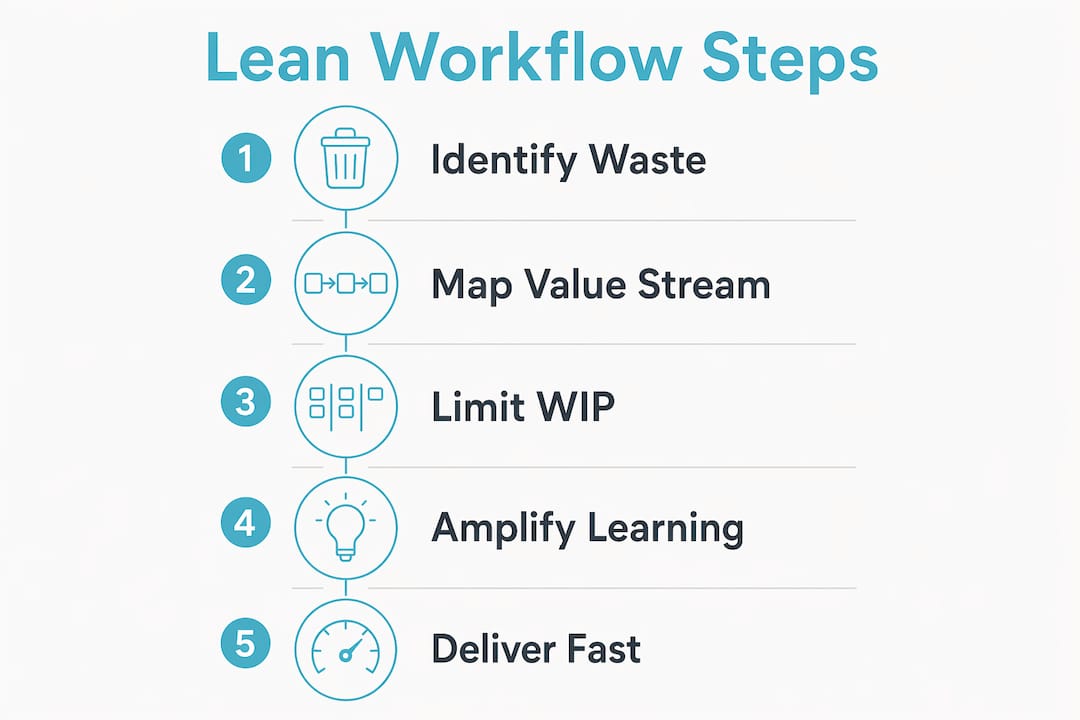
Implementation follows a sequence. Skipping steps or applying tools without understanding the underlying principle produces the appearance of lean without the results.
- Map your value stream. Value Stream Mapping identifies every step a work item passes through, from customer request to production deployment. Steps that do not add value are candidates for elimination. This single exercise often reveals that more than half of elapsed time is waiting, not working.
- Set WIP limits. WIP limits and pull systems are the mechanical heart of lean workflows. A WIP limit caps how many items can be in progress at once. When a column is full, the team pulls from upstream only when capacity opens. This prevents the pile-up of half-finished work.
- Build a pull system. Work moves through the system based on real demand, not on a push schedule. Teams pick up the next highest-priority item when they finish the current one. This keeps flow steady and prevents overproduction.
- Use visual management. Kanban boards make work visible. Every team member sees what is in progress, what is blocked, and where the bottleneck sits. Visibility is a prerequisite for improvement.
- Apply the Last Responsible Moment. Deferring decisions to gain more information is sound practice. The risk is deferring so long that the decision becomes urgent and rushed. Set a clear deadline for each decision and stick to it.
- Run Kaizen cycles. Continuous improvement (Kaizen) means holding regular retrospectives and acting on what you find. A retrospective with no follow-through is a waste of time. Assign owners and deadlines to every improvement action.
The table below shows how each practice maps to the lean principle it serves.
| Practice | Lean principle served |
|---|---|
| Value Stream Mapping | Eliminate waste |
| WIP limits | Deliver fast, optimize the whole |
| Pull systems | Deliver fast, empower the team |
| Kanban boards | Build quality in, optimize the whole |
| Last Responsible Moment | Decide late |
| Kaizen retrospectives | Amplify learning |
Successful lean adoption starts by targeting the single biggest bottleneck rather than applying every practice at once. One focused improvement beats six simultaneous experiments that produce noise instead of signal.
Pro Tip: Run your first Value Stream Map with the actual team members who do the work, not just managers. They know where the real waiting happens.
How does lean development compare to agile development?
Lean and agile are complementary, not competing. Lean provides the "why" and "how to optimize" the whole system, while agile defines the iteration rituals and collaboration methods that make delivery consistent. Teams that treat them as rivals miss the point of both.
The key differences are in focus and scope:
- Lean targets systemic waste across the entire delivery pipeline, from customer request through deployment and feedback.
- Agile frameworks like Scrum focus on iteration structure, sprint ceremonies, and team collaboration within a defined cycle.
- Lean thinking is a mindset about where value comes from. Agile is a set of practices for organizing work in time-boxed increments.
- Lean's "optimize the whole" principle explicitly warns against local optimization. Agile teams can fall into the trap of optimizing sprint velocity while ignoring upstream or downstream bottlenecks.
What is agile development without lean thinking? Often, it is a team that ships on a two-week cadence but still carries significant waste in its process. Adding lean principles to an agile practice closes that gap. The combination improves delivery speed, quality, and customer alignment simultaneously.
The most productive framing is this: lean is the operating philosophy, and agile provides the delivery mechanics. Neither is sufficient alone for teams building complex software at pace.
Lean should be understood as a mindset focused on removing systemic friction, not as a rigid methodology with prescribed ceremonies. Teams that adopt lean as a checklist get checklist results. Teams that internalize the principles find improvements in places they never thought to look.
Key takeaways
A lean development workflow delivers its full value only when teams treat waste elimination and continuous learning as permanent operating principles, not one-time projects.
| Point | Details |
|---|---|
| Seven core principles | Lean software development is defined by eliminate waste, amplify learning, decide late, deliver fast, empower the team, build quality in, and optimize the whole. |
| Start with mapping | Value Stream Mapping reveals where time is actually lost before any tool or practice is introduced. |
| WIP limits drive flow | Capping work in progress prevents task switching and keeps cycle times short and predictable. |
| Lean and agile complement each other | Lean supplies the optimization philosophy; agile supplies the iteration structure. Use both together. |
| Mindset over mechanics | Applying lean tools without empowering teams to act on what they find produces minimal lasting improvement. |
Why lean is harder than it looks, and worth it anyway
The honest truth about lean development is that the tools are simple and the mindset is hard. Any team can put a Kanban board on the wall. Far fewer teams will consistently act on what the board reveals, especially when it exposes a management decision as the bottleneck.
I have seen teams run Value Stream Mapping sessions, identify that 60 percent of their cycle time is waiting on code review, and then do nothing about it because the fix required a conversation with a senior engineer who was already overloaded. The board told the truth. The culture could not handle it.
Managers who fail to empower teams create cultural resistance that no tool can overcome. Lean requires that the people closest to the work have the authority to change it. Without that, you get compliance theater, not improvement.
The other trap is the Last Responsible Moment applied incorrectly. Teams use it as permission to avoid decisions indefinitely. The principle is about gathering information before committing, not about postponing until a deadline forces a rushed choice. I have watched projects lose weeks because a team kept deferring an architecture decision that was already well-understood. Set a date, make the call, and move.
Start smaller than you think you need to. Pick one bottleneck, apply one principle, measure the result, and then move to the next. Teams that try to transform everything at once usually transform nothing.
— Ben
How Agentcohort fits into a lean development environment
Lean workflows depend on visibility, reduced friction, and teams that can act without waiting for setup tasks to complete. Agentcohort is built around exactly those constraints.
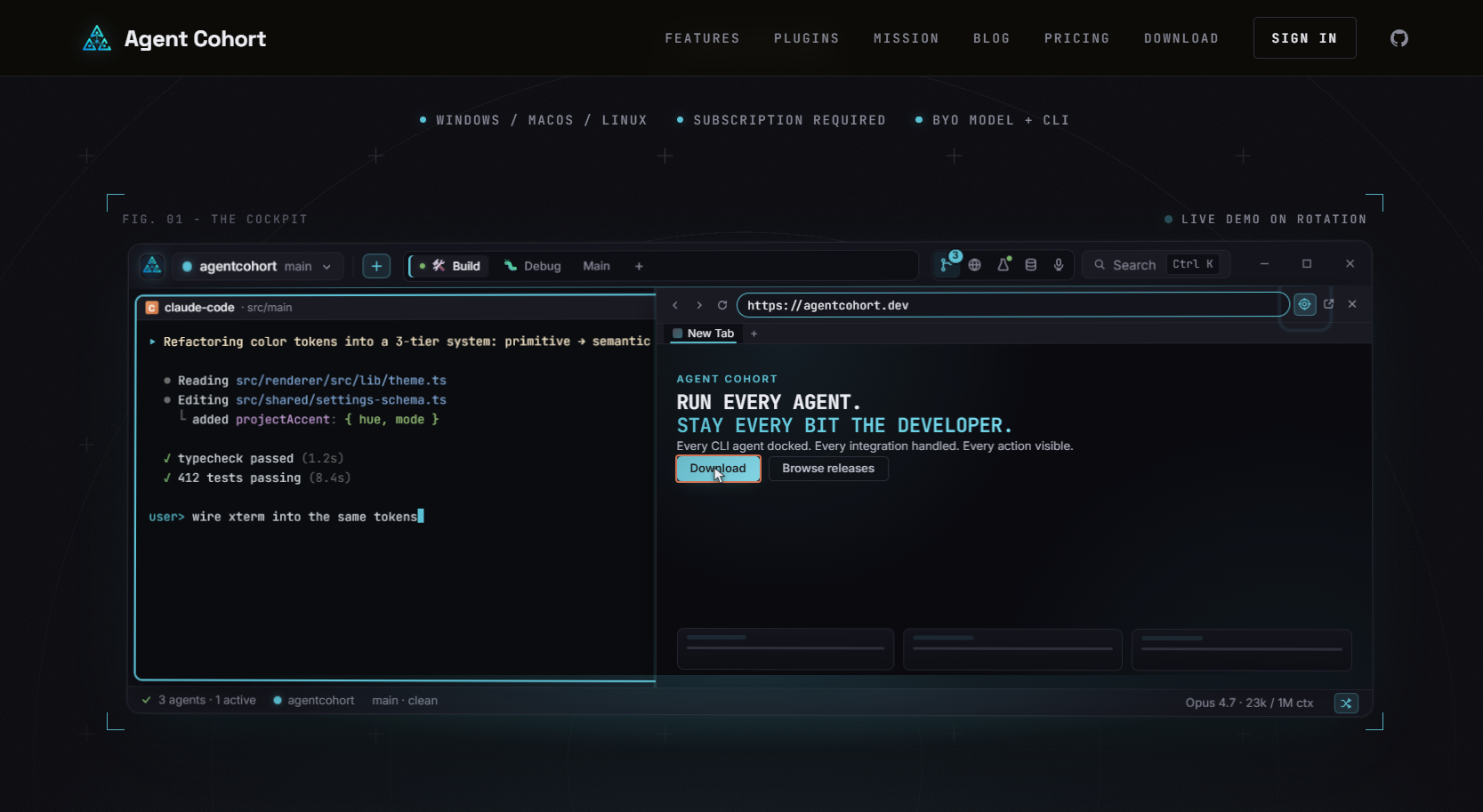
Agentcohort gives development teams a single workspace that integrates AI agents, including Claude Code and OpenAI Codex, into a multi-terminal grid where each project runs in its own dedicated environment. Setup tasks like installations and authentication are handled automatically, which removes a category of waiting waste that lean teams work hard to eliminate. Session persistence and customizable layouts mean teams maintain context across work sessions without rebuilding their environment from scratch. For teams applying lean principles to AI-assisted development, Agentcohort provides the visibility and control that lean workflows require.
FAQ
What is lean software development in simple terms?
Lean software development is a method that focuses on delivering only what adds customer value and removing every activity that does not. It applies manufacturing efficiency principles to software projects.
How is lean different from traditional project management?
Traditional project management pushes work through a fixed plan. Lean uses pull systems driven by real demand and continuously removes waste from the process rather than managing a predetermined schedule.
What are the seven lean development principles?
The seven principles are eliminate waste, amplify learning, decide as late as possible, deliver as fast as possible, empower the team, build quality in, and optimize the whole.
Can lean and agile be used together?
Yes. Lean and agile are complementary: lean provides the philosophy for optimizing the whole system, while agile supplies the iteration structure and collaboration practices.
Where should a team start with lean adoption?
Identify the single biggest bottleneck in your current workflow using Value Stream Mapping, then apply one lean principle to address it before moving on to the next improvement.