Agent-assisted development is defined as the practice of deploying autonomous AI agents as active participants across every stage of the software development lifecycle, from planning and coding through testing and deployment, under continuous human oversight. This is not autocomplete with a better UI. The industry term you will see in Forrester research is "agentic software development," and it represents a genuine architectural shift in how software gets built. The difference matters: a code completion tool waits for your cursor. An autonomous AI agent plans, executes, iterates, and reports back.
What is agent-assisted development, really?
Most engineers I talk to think they are already doing this. They are not. They are using AI autocomplete with extra steps. Agent-assisted software development means the AI holds a role on your team. It reads the spec, breaks the work into tasks, writes the code, runs the tests, reads the failure output, and tries again. That loop runs without you typing a single prompt after the first one.
Forrester defines this as the next phase beyond code assistants: AI agents that perform multi-step software lifecycle tasks under human supervision. The key word is "multi-step." A single model call that returns a function is not agentic. A model that calls tools, reads file systems, runs shell commands, checks test output, and revises its own work is agentic. That distinction changes everything about how you structure a team.
The agent-assisted development meaning also carries an organizational implication. AI agents are now first-class SDLC participants requiring a redesign of roles, metrics, and accountability. You do not just add a tool. You restructure the team around it.
How do autonomous AI agents function within the software development lifecycle?
The architecture behind agent-assisted development is more structured than most blog posts admit. Production teams deploy multi-agent architectures with specialized roles: planning agents, coding agents, review agents, and DevOps agents running concurrently. A typical configuration might include six coding agents and four review agents, each tuned to a different model capability profile.
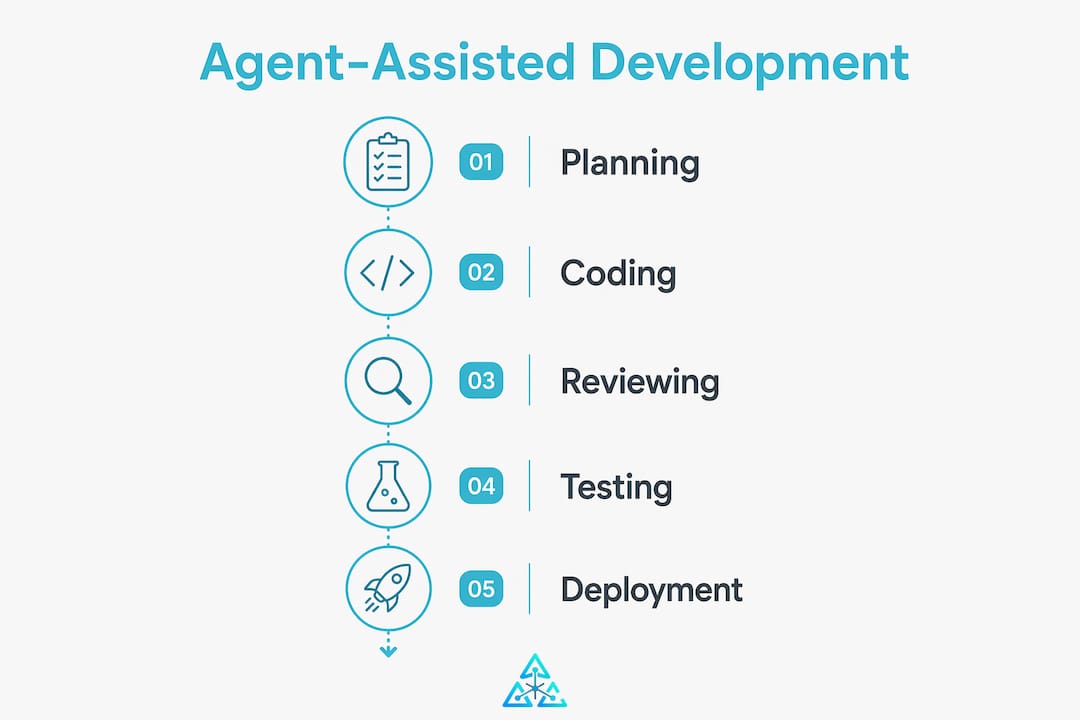
Here is how the workflow actually runs in practice:
- A planning agent reads the product spec and generates a task graph with dependencies.
- Coding agents pick up individual tasks and write implementation code in parallel.
- Review agents check each output for correctness, style, and security issues.
- A DevOps agent handles environment setup, CI triggers, and deployment gating.
- A human engineer reviews the final diff, approves merges, and handles escalations.
The coordination layer is what most teams underestimate. Agents do not just run in parallel. They pass structured outputs to each other through orchestration middleware. Spec-driven task planning keeps agents aligned to the original intent. Incremental iteration means each agent works on a bounded slice of the problem, not the whole codebase at once.
One technical mechanism worth knowing: Agent Skills files, sometimes called AGENTS.md, are configuration files that agents load to understand the codebase's conventions, build commands, and test expectations. Think of them as onboarding docs written for a machine. Without them, agents guess. With them, agents execute.
Security is not optional here. Credential brokering through middleware keeps agents from touching production secrets directly. MCP servers manage authentication and limit agent permissions to only the resources they need. Sandboxing prevents an agent from making irreversible changes without a human checkpoint.
Pro Tip: Write your AGENTS.md file before you run a single agent on a new project. Agents that lack explicit context about your build system will waste cycles on wrong assumptions, and you will spend more time debugging agent behavior than reviewing actual code.
What do real-world outcomes of agent-assisted development actually look like?
Here is the number that should reset your expectations. Narrow AI code generation yields roughly 10% team-level productivity gains. That is the ceiling for autocomplete-style tools. Full agentic workflows that cover planning, testing, and release compound efficiency significantly, with coding tasks improving 30–40% when agents handle the full loop.
That gap exists because the bottleneck was never typing speed. It was the handoffs: spec to ticket, ticket to code, code to test, test to review, review to deploy. Agents that own those handoffs eliminate the wait time between stages.
A representative workflow looks like this:
- Engineer writes a feature spec in plain language.
- A planning agent generates a task breakdown with acceptance criteria.
- Coding agents implement each task and commit to a feature branch.
- Review agents flag issues and suggest revisions automatically.
- The engineer reviews the final diff, merges, and the DevOps agent handles deployment.
The failure modes are just as instructive as the successes. Agents hallucinate and inject subtle bugs, especially in codebases with poor test coverage or ambiguous naming conventions. That is not a model problem. It is a codebase hygiene problem. Agents perform well on clean, well-documented code and poorly on legacy spaghetti. The AI is a mirror. It reflects the quality of what you give it.
Teams that see the biggest gains from agent-assisted software development share one trait: they invested in codebase maintainability before they introduced agents. The AI governance protocols that prevent disasters are not exotic. They are automated tests, clear documentation, and explicit build configuration. The teams that skip that step and jump straight to agents pay for it in debugging time.
How does this change engineering roles, metrics, and team structure?
The organizational shift is where most adoption plans fall apart. Engineers become directors in an agent-assisted model. They define the spec, set the guardrails, review the output, and make judgment calls on edge cases. The agent produces the first draft. The human decides if it ships.
That changes the seniority math. You need fewer engineers who can write boilerplate and more engineers who can evaluate whether an agent's output is correct, secure, and maintainable. Junior engineers who relied on repetitive coding tasks to build pattern recognition now need to build that skill differently.
Metrics shift just as dramatically. Lines of code and velocity points become meaningless when an agent can generate 500 lines in 90 seconds. The metrics that matter are outcome-based: defect escape rate, time to production, test coverage on agent-generated code, and rollback frequency. Those numbers tell you whether the agent is actually helping or just producing volume.
Pro Tip: Replace velocity as your primary sprint metric with defect escape rate on agent-generated code. If agents are shipping bugs that reach production, your governance layer is too thin. That number will tell you faster than any retrospective.
The governance challenge is real. Agent-driven development is a disciplined model, not ad-hoc prompt engineering. It requires explicit accountability: who owns the agent's output? Who reviews it? Who is responsible when it ships a bug? Those questions need answers before you run your first multi-agent workflow in production.
What best practices should teams follow to adopt agent-assisted development?
Adoption fails most often because teams treat agents like power users, not like new team members who need onboarding. The preparation work is not glamorous, but it is what separates teams that see compounding gains from teams that spend two weeks debugging agent behavior.
- Make the codebase agent-maintainable first. Agent performance depends heavily on clean, documented, test-stable codebases. Reliable tests and explicit build files are not nice-to-haves. They are prerequisites.
- Write explicit configuration files. AGENTS.md files and similar task-specific knowledge files tell agents how your project works. Load them before the agent touches a single file.
- Sandbox everything. Agents should never have direct access to production credentials. Credential brokering middleware controls what the agent can touch and logs every action.
- Automate testing for agent outputs specifically. Human review catches intent errors. Automated tests catch correctness errors. You need both running on every agent commit.
- Start with a multi-stage pilot. Run agents on a non-critical feature first. Measure defect rate, review time, and deployment success before expanding scope.
The partner link here is worth your time: AI in invention development covers how autonomous agents are reshaping engineering workflows beyond just code, which gives useful context for teams thinking about agents across the full product lifecycle.
Pro Tip: Run your first agent-assisted sprint on a feature with 80%+ test coverage. The agent will perform visibly better, and your team will build accurate intuitions about what agents can and cannot handle before you expose them to riskier work.
Key Takeaways
Agent-assisted development delivers compounding productivity gains only when teams invest in codebase quality, explicit agent configuration, and rigorous governance before running autonomous workflows in production.
| Point | Details |
|---|---|
| Definition is precise | Agent-assisted development means autonomous AI agents perform multi-step SDLC tasks, not just code completion. |
| Productivity gains compound | Narrow code tools yield roughly 10% gains; full agentic workflows reach 30–40% on coding tasks. |
| Codebase quality is the prerequisite | Agents perform well on clean, documented, test-stable code and poorly on legacy or ambiguous codebases. |
| Roles and metrics must change | Engineers shift to review and judgment work; outcome metrics replace velocity and lines of code. |
| Governance is non-negotiable | Credential brokering, sandboxing, and automated testing on agent outputs prevent production failures. |
Generation is solved. Verification is not.
I have been building software for over 15 years. I have watched the industry celebrate every new tool as the thing that finally fixes productivity. Most of them moved the bottleneck, not the ceiling.
Here is my contrarian read on agent-assisted development: the generation problem is largely solved. Models can write correct, idiomatic code for well-defined tasks at a speed no human matches. That part works. What does not work yet, reliably, is VERIFICATION. Knowing whether the agent's output is actually correct, secure, and aligned with the original intent is still a human problem. And most teams are not staffed or tooled to do that verification at the speed agents generate output.
I have seen teams ship agent-generated code that passed all automated tests and still introduced a subtle authorization bug. The tests were not wrong. The spec was ambiguous. The agent filled the ambiguity with a plausible but incorrect assumption. No one caught it until a user did.
The hype cycle around agentic development skips this part. It shows you the throughput numbers and does not show you the governance overhead required to make those numbers safe. The teams I respect most are the ones who treat agent oversight as a first-class engineering discipline, not an afterthought.
I built Agentcohort because I kept hitting the same wall: running multiple agents across a project meant losing track of what each one was doing. I needed a command deck, not another chat interface. I am biased, obviously. But the design decisions in Agentcohort came directly from those scars. Session persistence, per-project terminal grids, and visibility into agent actions are not features I invented. They are problems I got burned by first. If you want to build your own orchestration layer, do it. The concepts in this article are enough to get you started. Just budget more time for the governance layer than you think you need.
The teams that win with agent-assisted development are not the ones with the most agents. They are the ones who know exactly what each agent is doing at every moment.
— Ben
Agentcohort: a command deck built for agent-assisted teams
Running one AI agent on a project is manageable. Running six concurrently across three projects, each with its own environment, credentials, and task context, is where most setups break down.
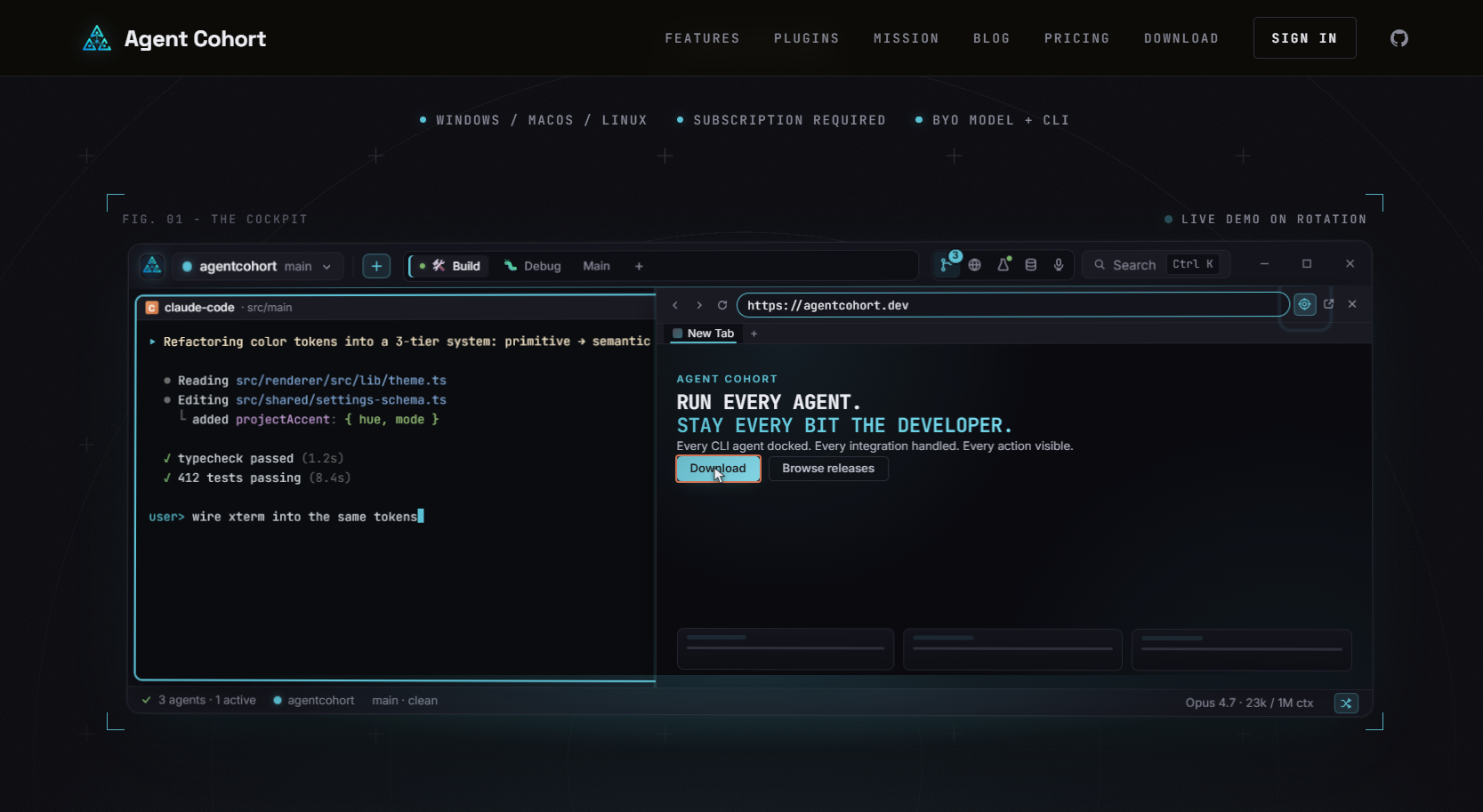
Agentcohort gives engineering teams a unified agent workspace built specifically for that problem. It integrates agents including Claude Code and OpenAI Codex into a multi-terminal grid where each project gets its own dedicated environment. Session persistence means agents do not lose context between runs. Automatic setup handles installations and authentication so your team focuses on review and judgment, not configuration. If you are serious about adopting agent-assisted development at the team level, Agentcohort is worth a look.
FAQ
What is agent-assisted development in simple terms?
Agent-assisted development is a software workflow where autonomous AI agents handle multi-step tasks across the full development lifecycle, including planning, coding, testing, and deployment, under human supervision. It goes well beyond AI code completion tools.
How does agent-assisted development work technically?
Specialized AI agents take on distinct roles such as planning, coding, reviewing, and DevOps, and coordinate through orchestration middleware. Configuration files like AGENTS.md guide agent behavior, while credential brokering middleware keeps production systems secure.
What are the real benefits of agent-assisted development?
Full agentic workflows improve coding task efficiency by 30–40%, compared to roughly 10% gains from narrow code-assist tools. The compounding gains come from agents owning the handoffs between SDLC stages, not just the code generation step.
What are common failure modes in agent-assisted software development?
Agents hallucinate and introduce subtle bugs, especially in codebases with poor test coverage or ambiguous documentation. Microsoft Research confirms that increased agent autonomy requires continuous human oversight and rigorous automated testing to catch these errors before production.
How should teams measure success with agent-assisted development?
Replace velocity and lines of code with outcome-based metrics: defect escape rate on agent-generated code, time to production, and rollback frequency. These numbers reveal whether agents are adding quality or just adding volume.