title: Why AI Agents Need Sandboxed Environments slug: why-ai-agents-need-sandboxed-environments meta_description: Generation is solved. Containment is not. Ben Dol on why sandboxed environments are the one engineering decision that separates safe AI agents from catastrophic ones. author: Ben Dol tags: [AI agents, sandboxing, security, developer tools, AI safety] status: publish
A sandboxed environment is an isolated execution container that prevents AI agent code from touching the host system, the network, or secrets it was never meant to see. Every serious team I know has learned this the hard way. The reason why AI agents need sandboxed environments is not philosophical. It is structural: AI agents execute code they generate at runtime, and that code is adversarial by nature, not accidental. The Linux kernel logs 300+ CVEs annually, which means shared-kernel containers are not a security boundary. They are a polite suggestion. Generation is solved. Containment is NOT.
Why do AI agents need sandboxed environments?
Traditional software fails because of bugs. AI agents fail because of adversaries. That distinction changes everything about how you design a security boundary.
A conventional web app runs code a human wrote, reviewed, and tested. An AI agent runs code an LLM produced at runtime, shaped by whatever prompt it received, including prompts an attacker injected. You cannot pre-review that code. You cannot sign it. You cannot know what it will do until it runs. This is the adversarial threat model that makes standard container isolation dangerously inadequate.
The risks stack fast:
- Prompt injection: A malicious string in a document the agent reads can redirect its tool calls, exfiltrate files, or call external APIs.
- Kernel exploits: Shared-kernel containers give every tenant the same kernel. One CVE and an attacker inside the container owns the host.
- Tool misuse: An agent with filesystem write access and no scope limit can overwrite configs, install backdoors, or delete production data.
- Secret leakage: Raw environment variables in a container are readable by any process the agent spawns.
The core engineering shift is treating all inputs as potentially adversarial and building execution sandboxes as the first response. Not the last. Most teams I have seen do the opposite. They ship the agent, then add sandboxing after the first incident. That is an expensive lesson.
What isolation tiers actually exist in 2026?
Not all sandboxes are equal. Five distinct isolation tiers exist for AI agents, and picking the wrong tier for your threat model is one of the most common mistakes I see.
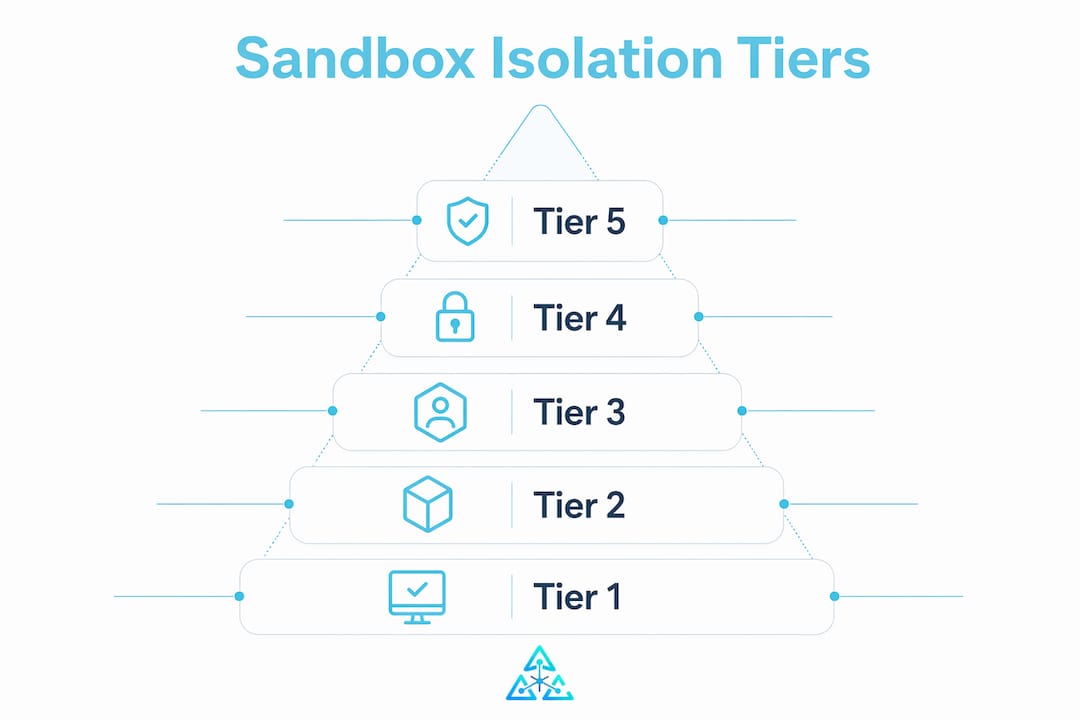
Tier 1: OS process constraints
Tools like Linux's seccomp and seatbelt on macOS restrict which system calls a process can make. They are lightweight and fast. They do not separate the kernel. A kernel exploit still escapes them.
Tier 2: Namespace and cgroup isolation
Standard Docker containers use Linux namespaces and cgroups. They isolate the filesystem, network, and process tree. The kernel is still shared. This tier is fine for trusted workloads. It is not fine for LLM-generated code.
Tier 3: User-space kernel emulation
gVisor interposes a user-space kernel between the container and the host kernel. Most syscalls never reach the real kernel. The attack surface shrinks dramatically. The performance cost is real, roughly 10–30% overhead on I/O-heavy workloads, but the security gain is significant.
Tier 4: Kata Containers
Kata Containers run each container inside a lightweight VM with its own kernel. The isolation is hardware-enforced. The startup time is higher than a plain container but lower than a full VM.
Tier 5: MicroVMs (Firecracker)
MicroVMs boot in 125ms with minimal overhead and full kernel separation. Firecracker, originally built by AWS for Lambda, is the gold standard for production AI agent sandboxing. A kernel exploit inside a Firecracker guest stays inside the guest. MicroVM escape exploits carry high bug bounty valuations precisely because they are rare.
| Tier | Technology | Kernel separation | Startup time | Best for |
|---|---|---|---|---|
| 1 | seccomp, seatbelt | None | Instant | Low-risk internal tools |
| 2 | Docker namespaces | None | Fast | Trusted workloads only |
| 3 | gVisor | Partial (user-space) | Fast | Medium-risk agents |
| 4 | Kata Containers | Full (VM) | Moderate | Production agents |
| 5 | Firecracker microVMs | Full (VM) | 125ms | High-risk, production-grade |
Pro Tip: If your agent can read user-supplied documents or call external APIs, start at Tier 4 or 5. The performance cost of Firecracker is far cheaper than a breach.
By 2026, sandbox architecture moved from optional to first-class design concern. Teams that treat it as an afterthought are building on sand.
How does layered defense go beyond isolation?
Isolation is necessary. It is not sufficient. Sandboxing limits the blast radius of AI agent actions. It does not make the agent trustworthy. You need layers.
The layers that actually matter in production:
- Network egress filtering: Deny-all egress by default and allowlist only the endpoints the agent legitimately needs. An agent that can call any URL can exfiltrate your entire database to a remote server.
- Filesystem scope limits: Mount only the directories the agent needs, read-only where possible. An agent with write access to
/etcis a liability. - Ephemeral lifecycles: Spin up a fresh sandbox for each task. Destroy it when the task ends. A persistent sandbox accumulates state, and accumulated state is accumulated risk.
- Credential brokering: Host-side proxies attach tokens dynamically, keeping secrets out of raw environment variables. The agent never sees the actual credential. It sees a scoped, short-lived token.
Pro Tip: Treat your sandbox's network policy like a firewall rule set. Write it down. Review it. Every open port is a decision, not a default.
The combination of hardware isolation, egress filtering, workspace confinement, and ephemeral lifecycles is what security engineers call defense-in-depth. Each layer assumes the previous one will eventually fail. That assumption is correct. You can learn more about how these patterns work in practice from this developer sandbox guide.
What practical approaches help developers test sandboxed agents?
Building the sandbox is half the job. Testing that it actually contains your agent is the other half. Most teams skip the second half.
-
Red-team your agent before release. The ProofAgent-harness tests against 183 traps, including prompt injections and tool misuse scenarios. Run it. If your agent fails 10 of 183, you have 10 production incidents waiting to happen.
-
Test multi-turn behavior, not just single prompts. Single-turn tests miss the drift that happens across a long conversation. The Terrarium framework supports environment snapshotting and state mutations, letting you test how an agent behaves as its environment changes across turns.
-
Validate your egress policy under load. Agents under load make more tool calls. More tool calls mean more chances to hit an unallowed endpoint. Stress-test your network policy, not just your isolation layer.
-
Choose your backend deliberately. Managed sandbox services reduce operational burden but add vendor dependency. Container backends are faster to set up but weaker on isolation. MicroVM backends are slower to configure but far safer for untrusted code. The right choice depends on your threat model, not your timeline.
-
Snapshot and replay. Capture sandbox state at key points. Replay it with different agent inputs. This is how you find environment-dependent bugs that only appear after several tool calls have mutated the workspace.
The importance of AI sandboxing extends to output validation too. A sandboxed agent that produces malformed output can still cause downstream failures. Pair sandbox containment with output schema validation at the boundary.
| Testing method | What it catches | Tooling example |
|---|---|---|
| Adversarial red-teaming | Prompt injection, tool misuse | ProofAgent-harness (183 traps) |
| Multi-turn state testing | Behavioral drift, environment bugs | Terrarium framework |
| Egress stress testing | Policy gaps under load | Custom load harnesses |
| Output schema validation | Malformed agent responses | JSON Schema, Pydantic |
Key Takeaways
Sandboxed environments are the non-negotiable containment layer for AI agents: without hardware isolation, egress filtering, ephemeral lifecycles, and adversarial testing, any agent running LLM-generated code is a production incident waiting to happen.
| Point | Details |
|---|---|
| Adversarial threat model | AI agents run runtime-generated code that cannot be pre-reviewed, unlike traditional software bugs. |
| MicroVMs over containers | Firecracker microVMs boot in 125ms and provide kernel separation that shared-kernel containers cannot. |
| Layered defense is mandatory | Isolation alone fails: add egress filtering, ephemeral lifecycles, and credential brokering. |
| Test adversarially | Use tools like ProofAgent-harness to catch prompt injection and misuse before release. |
| Multi-turn testing matters | Frameworks like Terrarium expose behavioral drift that single-turn tests miss entirely. |
The uncomfortable truth I've learned about AI sandboxing
I spent the first two years of my career in AI infrastructure assuming that containers were "good enough." They are not. I know this because I watched a shared-kernel container get exploited in a staging environment by a prompt injection that redirected an agent's shell tool. Nothing catastrophic happened that time. Luck, not engineering.
The mental model most developers carry is wrong. They think sandboxing is about stopping the AI from being "bad." It is not. Sandboxing is about assuming the AI WILL be exploited and making sure that exploitation stops at the sandbox wall. That is a completely different design philosophy, and it changes every decision you make.
The second thing I underestimated was environment mutability. An agent that runs 20 tool calls in sequence changes its own environment. By call 15, the filesystem looks nothing like it did at call 1. If you are not snapshotting and replaying that state in your tests, you are not testing the agent you are shipping. You are testing a cleaner, simpler version of it.
The third thing: credential management. I have seen teams inject AWS keys as plain environment variables into containers because "it's just a sandbox." A prompt injection that reads os.environ disagrees. Host-side credential proxies are not optional. They are the difference between a contained incident and a cloud bill that ends careers.
My honest take: governance validation matters as much as isolation. Sandboxing alone is not enough without adversarial testing. The teams winning in 2026 are the ones who treat their sandbox as a system to be attacked, not a checkbox to be ticked.
— Ben
Agentcohort: a command deck for sandboxed AI agent workflows
Running sandboxed AI agents across multiple projects is operationally complex. Each project needs its own isolated environment, its own credential scope, and its own network policy.
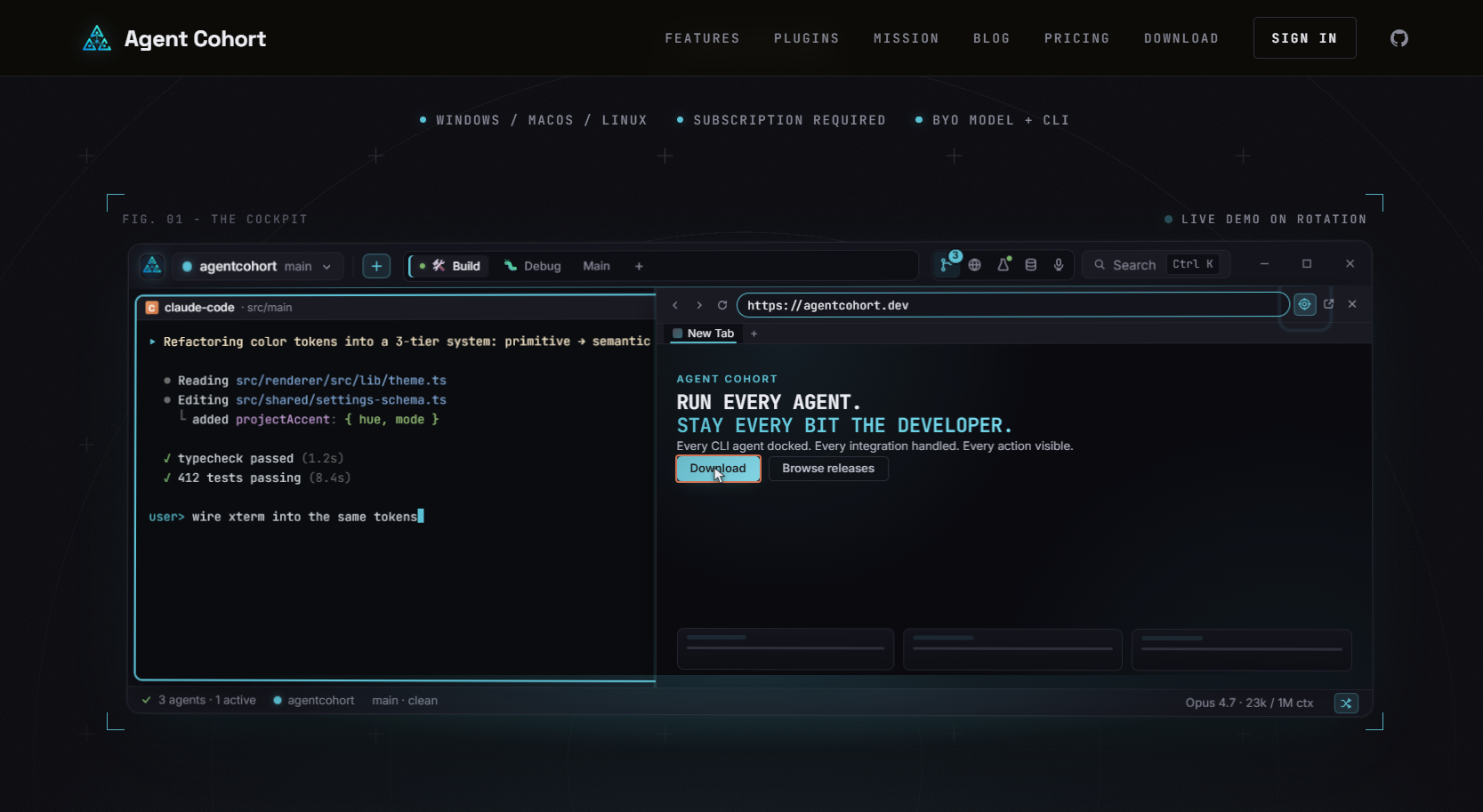
Agentcohort is built for exactly this problem. It gives developers a multi-terminal grid where each project runs in its own dedicated environment, with session persistence and automatic setup handling for installations and authentication. You get visibility into what each agent is doing across every environment, without stitching together five different tools. If you are managing more than one AI agent in production and want a structured way to handle the orchestration layer, Agentcohort is worth a look. DIY is always an option. This is the faster one.
FAQ
What is a sandboxed environment for AI agents?
A sandboxed environment is an isolated execution container that prevents AI agent code from accessing the host system, network, or credentials outside its defined scope. It limits the blast radius of any exploit or misuse.
Why are shared-kernel containers insufficient for AI agents?
The Linux kernel logs 300+ CVEs annually. A kernel exploit inside a shared-kernel container can compromise the host. MicroVMs like Firecracker provide kernel separation that containers cannot.
What is the fastest production-grade sandbox technology in 2026?
Firecracker microVMs boot in 125ms with full kernel separation. They are the current standard for production AI agent sandboxing where both speed and security matter.
How do I test whether my sandbox actually contains my agent?
Use adversarial red-teaming tools like ProofAgent-harness, which tests against 183 traps including prompt injections. Pair this with multi-turn state testing using frameworks like Terrarium.
What does defense-in-depth mean for AI agent sandboxing?
Defense-in-depth means layering hardware isolation with network egress filtering, ephemeral sandbox lifecycles, filesystem scope limits, and host-side credential brokering. Each layer assumes the previous one will eventually fail.