
AI agents are software systems that automate routine tasks, and early-stage teams use them to multiply output without multiplying headcount. The industry term for these systems is "autonomous AI agents," software that can plan, execute, and iterate on multi-step tasks without constant human input. Over 72% of high-growth startups now use AI agents to reduce manual work and improve decision speed. For a team of two or three people competing against funded rivals, that productivity gap is the difference between shipping and stalling.
Why early-stage teams use AI agents to automate workflows
The clearest reason startups adopt AI agents is time. Repetitive tasks like competitive research, outreach drafting, customer interview synthesis, and code scaffolding consume hours that founders cannot afford to lose. AI-assisted research workflows complete in 30 minutes tasks that previously took 5 hours. That is a 10x speed improvement on a single task type, and most early-stage teams have dozens of those tasks running every week.
The tasks AI agents handle best share one characteristic: they are repeatable and well-defined. Sending follow-up emails, tagging support tickets, pulling weekly metrics into a report, generating boilerplate code. These are not creative decisions. They are execution steps that follow a clear pattern every time. When a task fits that description, an AI agent can own it completely.
- Customer research synthesis: An agent reads transcripts, tags themes, and produces a summary document. Product-driven founders save 10–15 hours monthly synthesizing 30 or more customer interviews this way.
- Outreach and follow-up: Agents draft personalized cold emails, schedule sends, and log replies into a CRM without manual input.
- Code assistance: Agents like Claude Code and OpenAI Codex write boilerplate, generate tests, and flag errors before a human reviews the output.
- Data aggregation: Agents pull numbers from multiple sources and format them into a weekly dashboard, replacing a task that once required a junior analyst.
Pro Tip: Start automation on your most documented, repeatable task first. If you cannot write the steps on a single page, the workflow is not ready for an agent.
The compounding effect matters here. One automated workflow saves a few hours per week. Five automated workflows free up a full workday. For a team of three, that reclaimed time goes directly into product decisions, customer calls, and growth experiments.

What is the real ROI of AI agents for startups?
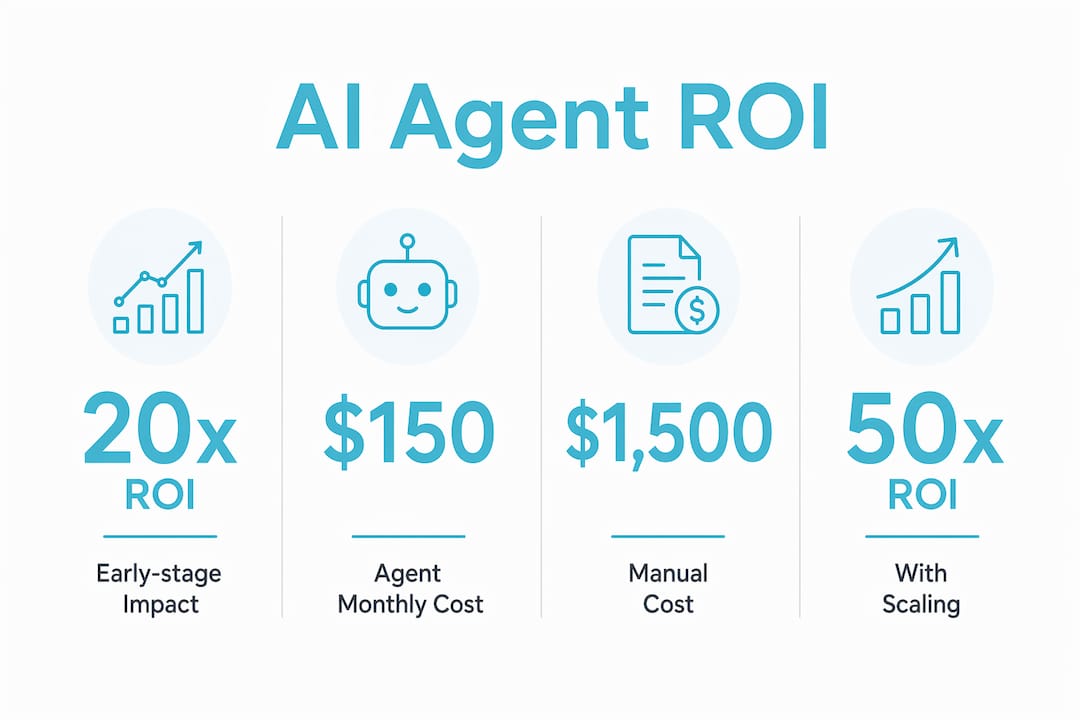
The financial case for AI agents is direct. Early-stage startups can achieve a 20x to 50x ROI on AI agent adoption, with monthly costs typically running $40–$150 while replacing $3,000–$10,000 in equivalent labor expenses. That math holds even when you account for setup time and occasional errors.
The comparison to freelancer or junior hire costs is the right frame. A part-time research contractor might cost $1,500 per month. An AI agent handling the same research tasks costs a fraction of that, runs 24 hours a day, and does not need onboarding. The savings are not theoretical.
| Task | Manual cost estimate | AI agent monthly cost | Estimated savings |
|---|---|---|---|
| Customer interview synthesis | $800–$1,200/month | $40–$80 | $760–$1,160 |
| Outreach drafting and follow-up | $600–$1,000/month | $30–$60 | $570–$940 |
| Weekly reporting and data pulls | $500–$900/month | $20–$50 | $480–$850 |
| Code scaffolding and test generation | $1,200–$2,000/month | $50–$100 | $1,150–$1,900 |
AI agents also allow founders to defer headcount growth while maintaining throughput. Hiring a fifth employee adds salary, benefits, management overhead, and onboarding time. Deploying an agent for the same repeatable work adds none of those costs. For a pre-seed team managing runway carefully, that deferral can extend the operating window by months.
The ROI calculation changes as the team scales. At the Series A stage, custom orchestration and security controls become necessary. But at the pre-seed and seed stage, off-the-shelf AI tools deliver the highest return per dollar spent.
How to implement AI agents in an early-stage startup
The biggest mistake founders make is deploying agents before their workflows are stable. Founders often over-invest in AI tools before workflows are clearly defined, which increases complexity and technical debt rather than reducing it. The agent amplifies whatever process it runs on. A messy process becomes a messy automated process, faster.
The right sequence looks like this:
- Document the workflow first. Write out every step of the task the agent will handle. If a human cannot follow the written steps reliably, an agent cannot either.
- Start with low-code tools. Early-stage teams benefit most from off-the-shelf, low-code AI agent platforms before investing in custom integrations. The goal is rapid results, not architectural elegance.
- Build controls around the agent. Define what the agent can and cannot do. Set clear tool schemas, exit conditions, and approval gates for any action that touches customers or money.
- Add automated testing. AI agents require well-documented processes and strict controls to avoid technical debt and unreliable automation. Run tests on agent outputs regularly, not just at launch.
- Scale complexity gradually. Add a second agent only after the first one runs reliably for four weeks. Stack complexity on proven foundations, not on assumptions.
Pro Tip: Keep a human in the loop for any agent output that reaches a customer or informs a major decision. Agents are fast. Humans catch the edge cases agents miss.
Observability is the part most teams skip. Careful orchestration and detailed logs are critical because AI agents have failure modes that standard software does not. An agent can confidently produce a wrong answer. Without audit trails and retry mechanisms, you will not catch the error until it causes a real problem.
How do AI agents improve team collaboration and decision-making?
AI agents function as virtual teammates that coordinate information across a team. The most direct impact is on knowledge sharing. When an agent synthesizes 30 customer interviews into a structured summary, every team member reads the same document. There is no version where the founder holds all the context and the engineer works from a secondhand summary.
AI agents synthesize customer feedback, route support tickets, and surface patterns that inform product decisions. That function replaces hours of manual tagging and sorting. It also reduces the cognitive load on founders who are already managing sales, product, and hiring simultaneously.
The impact on team dynamics is real:
- Faster decisions: When an agent surfaces the top five customer complaints from the past month, the product meeting starts with data instead of debate.
- Reduced founder burnout: Automating information gathering means founders spend less time in operational tasks and more time on judgment calls.
- Consistent communication: Agents that draft status updates or meeting summaries keep the whole team aligned without requiring a dedicated operations person.
- Scalable onboarding: An agent that documents processes and answers common questions reduces the time a new hire needs to become productive.
The key distinction is that AI agents accelerate data-driven decisions while preserving human judgment. The agent surfaces the pattern. The founder decides what to do about it. That division of labor is where early-stage teams get the most value from AI-powered collaboration.
Key Takeaways
Early-stage teams that deploy AI agents on documented, repeatable workflows see the fastest and most durable productivity gains.
| Point | Details |
|---|---|
| Start with documented workflows | Deploy agents only on tasks with clear, written steps to avoid scaling confusion and technical debt. |
| ROI is measurable and fast | AI agents can deliver 20x to 50x ROI by replacing $3,000–$10,000 in labor at $40–$150 per month. |
| Use low-code tools first | Off-the-shelf platforms deliver rapid results before custom orchestration becomes necessary. |
| Keep humans in the loop | Agents handle execution; humans handle judgment, especially for customer-facing outputs. |
| Agents defer hiring, not replace thinking | AI agents extend runway by automating repeatable work, freeing founders for strategic decisions. |
What I have learned about AI agents and sustainable startup growth
The conversation around AI agents tends to split into two camps. One side treats agents as a magic productivity multiplier. The other dismisses them as overhyped tools that break at the worst moment. Both camps are wrong in the same way: they are arguing about the tool instead of the workflow.
Every time I have seen an early-stage team struggle with AI agents, the problem was not the agent. The problem was that the team automated a process they had not fully understood yet. The agent ran fast and confidently in the wrong direction. That is not a technology failure. That is a process failure with a fast engine attached.
The teams that get genuine value from AI agents share one habit: they document before they automate. They know exactly what the task requires, where the edge cases live, and what a good output looks like. When those conditions exist, an agent is genuinely transformative. When they do not, the agent creates more work than it saves.
The other thing I would push back on is the framing of AI agents as a replacement for strategic roles. An agent can synthesize 30 interviews. It cannot decide which customer segment to prioritize. An agent can draft 200 outreach emails. It cannot read the room in a sales call. The founders who get the most from AI agents are the ones who are clear about that boundary and protect it deliberately.
Start small. Measure the output. Scale what works. That is not a cautious approach. That is the only approach that compounds.
— Ben
Agentcohort: a developer command deck for AI agents
Early-stage teams often end up managing multiple AI agents across disconnected tools, which creates exactly the kind of fragmentation that slows teams down. Agentcohort is built to solve that problem directly.
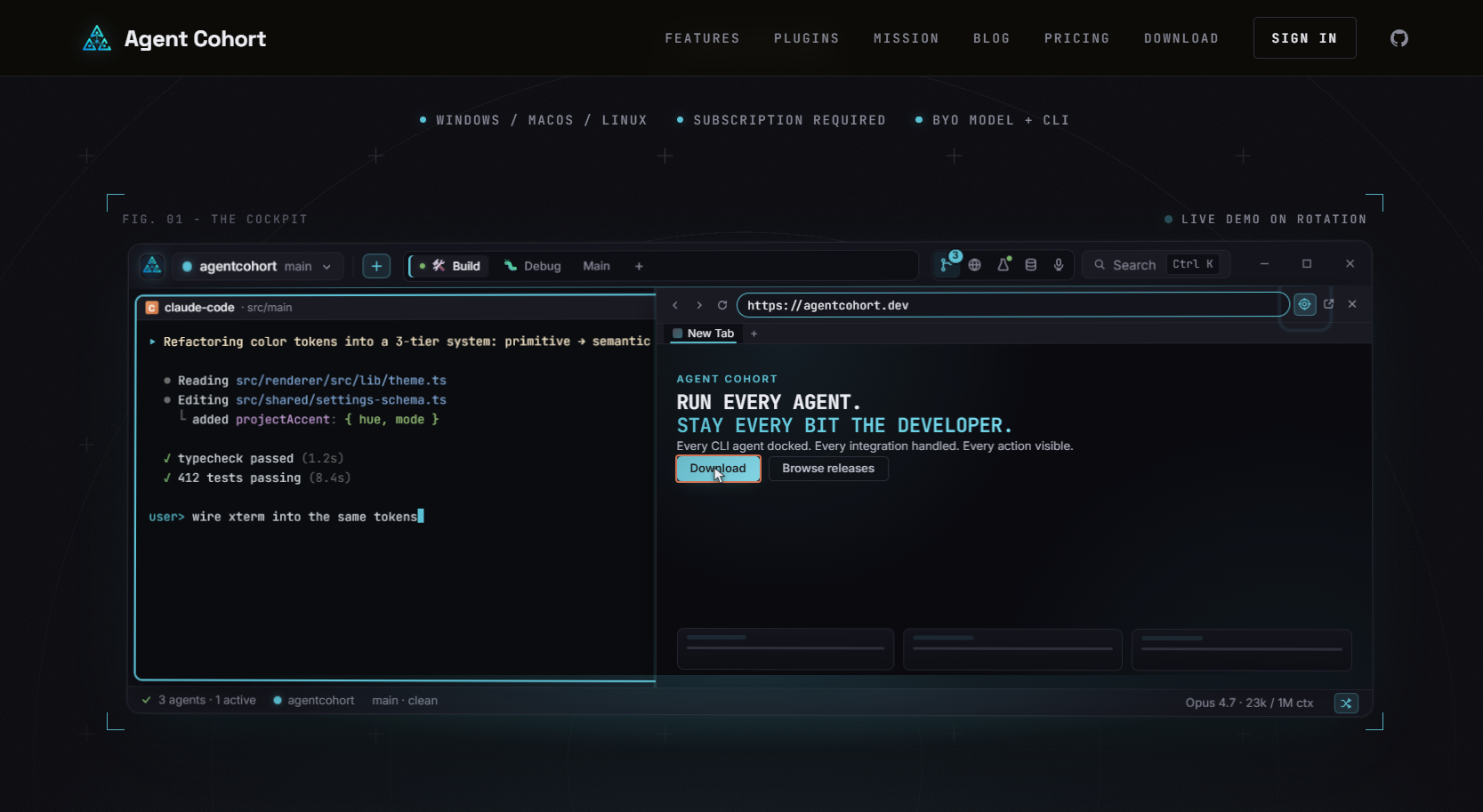
Agentcohort provides a multi-terminal grid where each project gets its own dedicated environment, integrating agents like Claude Code and OpenAI Codex into a single workspace. Setup tasks like installations and authentication are handled automatically, so your team focuses on the work instead of the configuration. Session persistence and customizable layouts mean you maintain full visibility over what each agent is doing, without losing context between sessions. For founders who want control over their AI agent workflows without building custom infrastructure from scratch, Agentcohort is worth a close look.
FAQ
Why do early-stage teams use AI agents instead of hiring?
AI agents automate repeatable tasks at a fraction of the cost of a hire, with monthly costs of $40–$150 replacing $3,000–$10,000 in equivalent labor. They allow lean teams to maintain output while preserving runway for strategic roles.
What tasks are AI agents best suited for in a startup?
AI agents perform best on well-defined, repeatable tasks like customer research synthesis, outreach drafting, data reporting, and code scaffolding. Tasks requiring judgment, relationship management, or creative strategy still need a human.
How do you avoid technical debt when deploying AI agents?
Document the workflow completely before deploying an agent, and build strict controls including tool schemas, exit conditions, and automated testing. Agents deployed on unstable processes amplify the instability rather than fixing it.
When should a startup move from low-code AI tools to custom orchestration?
Low-code tools are the right starting point for pre-seed and seed-stage teams focused on speed. Custom orchestration becomes necessary when security requirements, workflow complexity, or scale outgrow what off-the-shelf platforms can handle reliably.
Do AI agents replace team members in early-stage startups?
AI agents defer hiring by automating repeatable work, but they do not replace the judgment, relationships, or strategic thinking that define early-stage team roles. The best use of agents is freeing founders to focus on decisions only humans can make.